

November 4, 2026 · Editorial Team
Custom Peptide Synthesis Companies for Research Compared
Compare custom peptide synthesis companies on purity testing, turnaround time, pricing drivers and documentation. Find the right supplier for your lab.
Quick Summary
Custom peptide synthesis is the production of a specific amino acid sequence built to your order, then purified, verified and shipped. The right provider depends on sequence length, scale, modifications, purity grade and documented testing. Request the same specification from each supplier to compare quotes fairly.
- Compare every supplier against the same checklist of sequence length, scale, purity and modifications.
- Match the purity grade to your experiment, since crude peptide suits screening while high-purity grades suit sensitive in vitro work.
- Ask each supplier for an itemized five-line quote covering synthesis, purification, analytics, modifications and shipping.
- Request a sample Certificate of Analysis and confirm the purity method before committing to an order.
- Boster Bio lists crude peptide from per amino acid, but this excludes purification and testing costs.
Table of Contents
- What a Custom Peptide Synthesis Company Actually Delivers
- Side-by-Side Comparison of Supplier Options
- Custom Peptide Synthesis Price: What Drives the Quote
- Research Peptide Purity Testing and Acceptance Criteria
- Peptide Synthesis Turnaround Time and Shipping Considerations
- Choosing Your Synthesis Partner and Requesting a Quote
- Frequently Asked Questions
What a Custom Peptide Synthesis Company Actually Delivers
Last Updated: November 4, 2026
Choosing among custom peptide synthesis companies for research starts with knowing what you are actually buying. Quality Peptide USA focuses on research-grade peptides made, tested and packaged in the United States, and this guide explains the variables that separate one supplier's offer from another's. (Source: the U.S. Small Business Administration (SBA) resources)
Most suppliers describe their services in similar terms, so the real differences hide in the details. Length, scale, modifications and purity grade all change the work involved and the final cost. Read each supplier's specifications against the same checklist, and the comparison becomes far easier.
Sequence length, scale and modifications
Sequence length is the first variable to check. Each added amino acid adds synthesis steps, and longer or more complex sequences are harder to complete at high purity.
Scale refers to how much peptide you receive, often expressed in milligrams. Small research quantities and larger batches usually follow different pricing and production paths.
Modifications, such as labels or other chemical changes, are common requests. Common examples include fluorescent labeling, biotinylation and phosphorylation.
Crude, purified and high-purity grades
Peptides ship in different purity grades. Crude peptide contains the target sequence along with synthesis by-products. It suits some screening work where exact purity matters less.
A common mistake is ordering a grade based only on price. Match the grade to the experiment. Ask each supplier for the purity method used and a sample Certificate of Analysis before you commit.
Side-by-Side Comparison of Supplier Options
Most supplier pages describe their own services well and say little about anyone else's. That makes a neutral comparison hard to find, and it is the main reason buyers end up requesting five quotes against five different specifications. The fix is to compare every supplier against the same criteria, in the same order, using the same units.
The criteria that actually separate suppliers
Use this checklist for every quote you request. It is ordered by how often a difference here changes the total project cost or the timeline.
- Sequence length capability. Ask for the longest sequence the supplier will routinely synthesize at your target purity, and how it handles sequences above that threshold. Long sequences are where yield drops and where resynthesis policies matter most.
- Scale options. Confirm the smallest and largest batch sizes offered, in milligrams or grams, and whether the price per milligram changes at higher scale.
- Purity grades and the method used to measure them. Ask whether purity is measured by HPLC and at what wavelength, and whether mass spectrometry is included by default or as an add-on.
- Modifications offered in-house. Fluorescent labels, biotinylation, phosphorylation, cyclization, and non-natural amino acids are not universally available. Confirm which are done in-house versus subcontracted, because subcontracting adds lead time.
- Analytical deliverables. Ask exactly what ships with the batch: Certificate of Analysis, HPLC chromatogram, mass spec trace, and batch-specific documentation. Some suppliers provide these only on request.
- Difficult-sequence handling. Ask about feasibility review before the order is accepted, and what happens if synthesis underperforms the quoted purity.
- Lead time and shipping. Get a quoted turnaround in business days for your specific sequence, not a generic range, and confirm shipping terms and replacement policy for damaged shipments.
- Quote turnaround. A supplier that takes a week to quote is a different partner than one that quotes in a day, especially for iterative work.
How the shortlisted suppliers line up
The table below uses only information the suppliers publish or that was available in the research for this guide.
| Criterion | Quality Peptide USA | GenScript | Biosynth | Biomatik | Boster Bio |
|---|---|---|---|---|---|
| Pricing model | Quote-based | Custom quote | Custom quote | Custom quote | Per amino acid, from (crude) |
| Published purity options | HPLC-verified 99%+ | Confirm in quote | Confirm in quote | Confirm in quote | Crude to greater than 98%; ultra-pure listed up to per amino acid at 5 mg scale |
| Synthesis approach | Confirm in quote | Microwave synthesis | Multiple service brands (vivitide, Pepscan, Cambridge Research Biochemicals, Pepceuticals) | Confirm in quote | Confirm in quote |
| Modifications | Confirm in quote | Confirm in quote | Confirm in quote | Confirm in quote | Confirm in quote |
| Analytical deliverables | Third-party Certificate of Analysis and HPLC verification per batch | Confirm in quote | Confirm in quote | Confirm in quote | Confirm in quote |
| Lead time | Domestic delivery in 2-3 business days; same-day shipping before 2PM EST | Confirm in quote | Confirm in quote | Confirm in quote | Confirm in quote |
| Shipping and replacement | Free replacement for products damaged in transit | Confirm in quote | Confirm in quote | Confirm in quote | Confirm in quote |
| Stated focus | US-based synthesis, packaging and supply chain | Epitope mapping and drug discovery support | Multi-brand service breadth | Academic and industry researchers; 20+ years in life sciences | Broad catalog and custom synthesis |
A blank or "confirm in quote" cell is not a knock on the supplier. It means the information is not public, and the only honest way to fill it is to ask.
Watch out: comparing a published per-amino-acid rate against a quote-based price is not a like-for-like comparison.
Reading the table by research use case
The right supplier depends on what the peptide is for, not on which row looks fullest.
- Antibody generation and epitope mapping. Prioritize suppliers that routinely handle longer sequences and offer carrier-protein conjugation and immunization-grade purity. GenScript explicitly supports epitope mapping, and Quality Peptide USA's US-based production shortens the feedback loop for iterative epitope work.
- Screening and assay development. Crude or desalted peptide at moderate purity is often sufficient and is the cheapest path. Boster Bio's published per-amino-acid crude pricing is a useful benchmark here.
- Sensitive in vitro and preclinical work. Require HPLC-verified high purity, mass confirmation, and endotoxin testing where relevant. Confirm the analytical deliverables in writing before ordering.
What to do with the comparison
Send the same specification to each shortlisted supplier: sequence, scale, purity grade, modifications, required analytical tests, and deadline. Then fill the table with the answers. The supplier that returns a complete, itemized quote against your specification is usually the one that will also document the batch properly, because both behaviors come from the same internal process.
Custom Peptide Synthesis Price: What Drives the Quote
Custom peptide synthesis pricing is quote-based at most suppliers, which makes it hard to compare. The way to compare is to understand the cost drivers, price each one against your own specification, and ask for an itemized quote rather than a single number.
The five cost drivers, in order of impact
- Sequence length. Every additional amino acid adds coupling and deprotection steps, so cost rises roughly with length. The relationship is not perfectly linear because longer sequences also carry higher failure risk, and suppliers price that risk in.
- Purity grade. Crude peptide is the cheapest grade. Each purification step adds cost, and high-purity grades add the most because they require more chromatography and more material lost to purification. Expect the price gap between crude and high-purity to be larger than most first-time buyers anticipate.
- Scale. Price per milligram usually falls as batch size rises, but total cost rises. Ask for pricing at two or three scales so you can see the per-milligram curve rather than a single point.
- Modifications. Labels, conjugations, cyclization, and non-natural amino acids add both reagent cost and handling time. Each modification should be a separate line item on the quote.
- Turnaround. Expedited production typically carries a premium. If your timeline is flexible, say so, because some suppliers price standard turnaround lower than rush.
Published benchmarks and how to read them
Only a minority of suppliers publish any price.
To turn a per-residue rate into an estimate, multiply by sequence length, then add purification, analytical testing, modifications, and shipping.
Quality Peptide USA prices by quote, with the figure depending on quantity, delivery timing, and specifications. Request a quote with your exact sequence and required deliverables so the number is comparable to the other quotes you collect.
Building a total project cost
Ask every supplier for the same five-line breakdown so the quotes can be compared directly:
- Synthesis at your specified scale and purity
- Purification to the requested grade
- Analytical testing (HPLC, mass spectrometry, and any additional tests such as endotoxin)
Add a contingency line for resynthesis if your sequence is difficult. A supplier that quotes a low price but excludes analytical testing is not cheaper; it has simply moved a cost off the quote.
Watch out: a quote that does not state the purity method, the scale, and whether analytical testing is included cannot be compared to another quote. Ask for those three items in writing before you treat any price as final.
Where cost and risk trade off
Cheap crude peptide is the right choice for screening work where a mixed product will not distort the result. For sensitive in vitro or preclinical work, the cost of a failed experiment usually exceeds the price difference between crude and high-purity grades. The same logic applies to difficult sequences: paying for feasibility review and a documented resynthesis policy upfront is often cheaper than discovering after delivery that the batch underperformed.
How to request a comparable quote
Send each supplier the same package: full sequence, scale, purity grade, list of modifications, required analytical tests, and deadline. Ask for the five-line cost breakdown above, the purity method, a sample Certificate of Analysis, and the quoted lead time in business days. Quality Peptide USA's staff researchers can help you match the grade and scale to your study; visit the website to request a quote and compare the itemized breakdown against your other quotes.
Research Peptide Purity Testing and Acceptance Criteria
Purity claims should be verifiable. Ask for a Certificate of Analysis for each batch, and check that it reports the analytical method used. HPLC is the most common method for measuring purity, and mass spectrometry confirms that the peptide has the expected molecular weight.
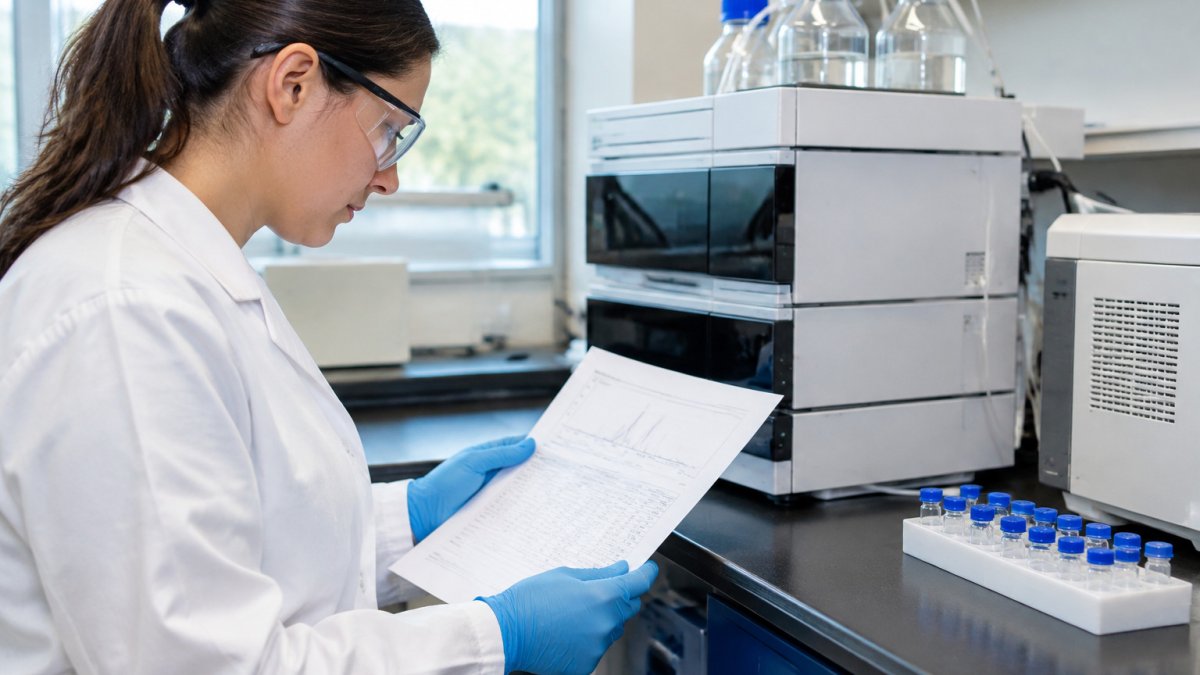
Set acceptance criteria before you order. Define the minimum purity, the identity confirmation method and any additional tests your work requires, such as endotoxin testing for sensitive in vivo studies.
Peptide Synthesis Turnaround Time and Shipping Considerations
Turnaround time varies with sequence complexity, scale and modifications. Simple peptides can ship faster than long or heavily modified ones. Quality Peptide USA lists fast domestic delivery within 2-3 business days and same-day shipping for orders placed before 2PM EST.
Plan for delays. Ask each supplier how it handles batch issues and whether it offers replacements for damaged shipments. Quality Peptide USA states that it provides free replacement for products damaged in transit.
Choosing Your Synthesis Partner and Requesting a Quote
Start by listing your sequence, scale, required purity, modifications and testing needs. Send that same specification to each shortlisted provider so the quotes are comparable.
When you request a quote, ask for the purity method, a sample Certificate of Analysis, lead time and the full cost breakdown. Quality Peptide USA's staff researchers can help you match the grade to your study.
Frequently Asked Questions
Who are the best vendors for research peptides?
The best vendor depends on what your project needs. Compare suppliers on sequence length limits, the purity grades they offer, whether they supply a third-party or in-house Certificate of Analysis with mass spectrometry and HPLC data, and their lead times. Request a quote from two or three providers using the same sequence and specification, then compare the documentation and delivery terms side by side before deciding.
How much does it cost to synthesize a peptide?
Pricing depends on sequence length, purity grade, synthesis scale, modifications and delivery timing. Some suppliers list per-amino-acid rates that vary by purity and scale; for example, one listed crude-grade starting price is per amino acid. Because published rates differ in what they include, ask each provider for a full quote covering purification, analytical testing and shipping before comparing totals. Quality Peptide USA prices depend on quantity, dates and delivery, so request a current quote from its website.
How do peptide synthesis companies verify purity and identity?
Most providers confirm identity with mass spectrometry and measure purity with HPLC, then report both on a Certificate of Analysis. Check whether the report shows the actual chromatogram and mass data, not just a percentage. If your lab needs independent confirmation, ask whether the supplier accepts re-testing and what acceptance criteria apply if your results do not match.
How long does custom peptide synthesis take?
Turnaround depends on sequence length, complexity, scale and the purification method. Shorter, straightforward sequences generally move faster than long or difficult ones, which may need additional coupling cycles and purification steps. Ask each supplier for a stated lead time for your specific sequence, and confirm whether shipping is included in that estimate.
