

October 23, 2026 · Editorial Team
Domestic vs International Peptide Supply: A 2026 Guide
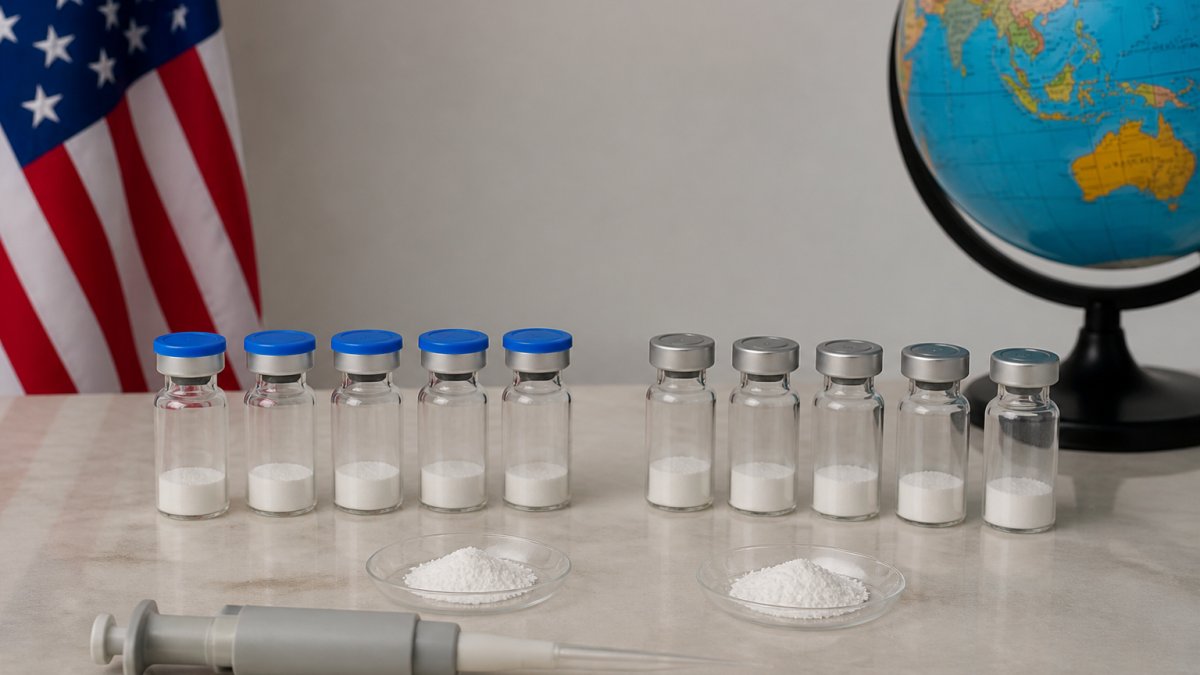
Domestic vs international peptide supply: Compare domestic and international peptide suppliers.
Last Updated: October 23, 2026
Quick Summary
Domestic vs international peptide supply involves trade-offs between cost, speed, and quality assurance. Domestic suppliers offer faster 2-3 day delivery, cGMP compliance, and third-party testing, while international sources typically cost 30-50% less but introduce 10-21 day lead times, customs delays, and variable quality control.
- Domestic peptides arrive in 2-3 business days; international shipments take 10-21 days plus 3-7 day customs clearance.
- International peptides cost 30-50% less per unit, but landed costs shrink when accounting for delays, re-testing, and failed experiments.
- Verify suppliers by confirming cGMP certification, FDA registration number, and independent third-party HPLC testing on Certificates of Analysis.
- Domestic suppliers provide transparent cold-chain management and replace damaged batches; international transit risks temperature excursions over longer periods.
- Choose domestic supply for time-sensitive research and high-sensitivity studies; choose international supply only with budget flexibility and timeline predictability.
Table of Contents
- Domestic vs International Peptide Supply: Key Differences
- How to Verify a Peptide Supplier and Assess Legitimacy
- Peptide Certificate of Analysis: What to Expect and Verify
- Peptide Shipping and Lead Times: Domestic vs International
- Research Peptide Supplier Checklist: Evaluating Your Options
- Regulatory and Import Considerations for Peptide Sourcing
- When to Choose Domestic vs International Peptide Supply
- Frequently Asked Questions
Domestic vs International Peptide Supply: Key Differences
When you're sourcing research peptides, the choice between domestic vs international peptide supply shapes cost, delivery speed, regulatory compliance, and risk.
Domestic suppliers operate within the same regulatory framework as your lab, offer faster turnaround, and provide transparent quality documentation. International suppliers typically cost less per unit but introduce customs delays, longer lead times, and higher variability in quality assurance.
Manufacturing Location and Country of Origin
The country where your peptides are synthesized affects regulatory oversight, quality control standards, and supply chain transparency. Domestic manufacturers in the United States operate under FDA oversight and cGMP compliance requirements, meaning facility inspections, documented standard operating procedures, and traceable batch records (the FDA).
When you source domestically, you know exactly where synthesis occurs and can verify manufacturing credentials, audit facility practices, and confirm documented protocols.
Quality Peptide USA maintains 100% U.S.-based synthesis and packaging. Every batch originates from a single domestic facility operating under cGMP standards, which means you're not dealing with supply chain fragmentation or multiple manufacturing locations with different quality controls.
Price Differences and Cost Trade-Offs
International suppliers typically undercut domestic pricing significantly, thanks to lower labor costs, less stringent regulatory overhead, and higher production volumes.
However, the landed cost tells a different story.
For small research teams and independent PIs, the upfront price difference is real and meaningful. For larger institutions running multiple concurrent studies, the total landed cost, including time, risk, and contingency, often favors domestic supply.
How to Verify a Peptide Supplier and Assess Legitimacy
Supplier verification is non-negotiable. The peptide market includes legitimate research-grade manufacturers alongside vendors selling mislabeled or contaminated products.
Checking Manufacturing Credentials and cGMP Compliance
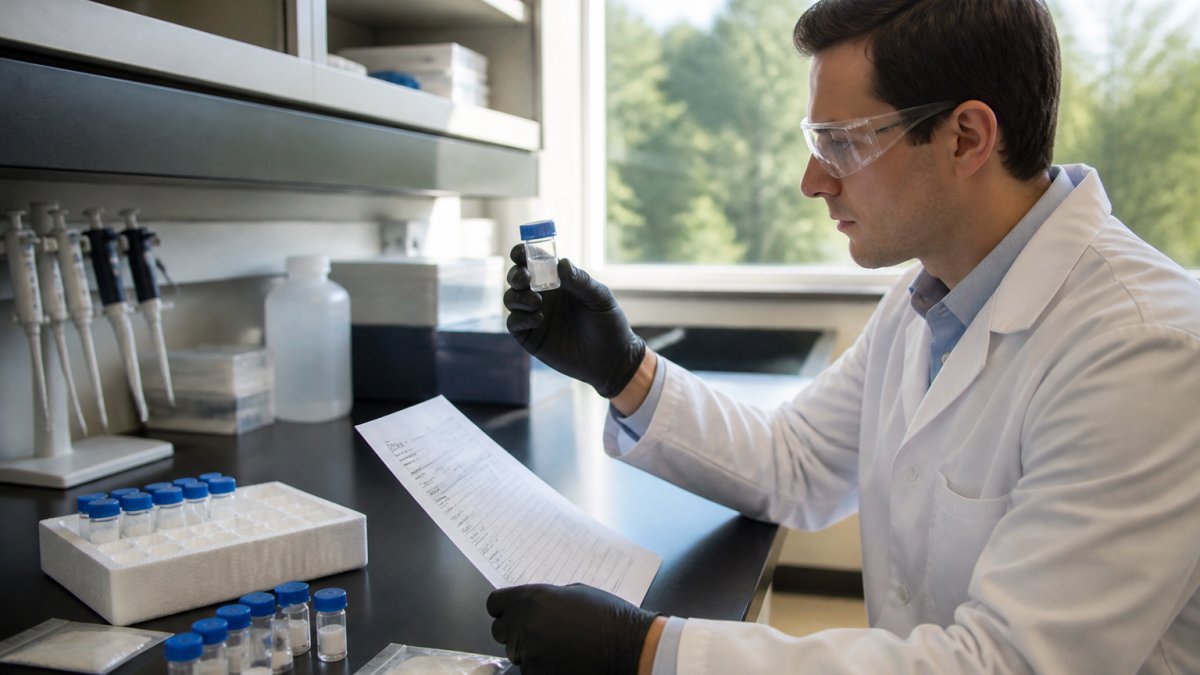
Start by confirming the supplier operates under cGMP (current Good Manufacturing Practice) certification, the U.S. regulatory standard for pharmaceutical and research-grade manufacturing.
Ask for the supplier's FDA establishment registration number. Domestic manufacturers synthesizing for research use should be registered with the FDA. This is a basic verification step that eliminates many illegitimate operators immediately.
Request documentation of their quality control procedures: how they validate each batch, what testing protocols they use, and how they handle deviations.
Red Flags in Supplier Verification
Several warning signs indicate a supplier may not be trustworthy.
Extremely low pricing relative to competitors suggests unsustainable business practices or cut corners.
Vague answers about manufacturing location or sourcing are warning signs.
Slow response times to technical questions or quality concerns indicate poor support infrastructure. If communication is sluggish before you buy, it will be worse after.
Peptide Certificate of Analysis: What to Expect and Verify
A Certificate of Analysis (CoA) is your proof that a peptide batch meets stated specifications. It documents purity, identity, and contamination screening. Not all CoAs are equally rigorous, and learning to read one is essential for protecting your research.
Understanding HPLC Testing and Purity Claims
High-Performance Liquid Chromatography (HPLC) is the gold standard for peptide purity analysis, separating components and quantifying the desired compound versus impurities (pubmed.ncbi.nlm.nih.gov). When a supplier claims 99% purity, that number should come from HPLC data, not less rigorous methods.
A proper HPLC report includes a chromatogram, the integration method, the calculated purity percentage, and the detection wavelength and column used, since these details affect reproducibility across batches. Learn how HPLC, MS, and endotoxin testing are performed and reported for research-grade peptides.
When reviewing an HPLC result, verify that the peak corresponding to your peptide is clearly separated from other peaks.
Third-Party Testing vs Supplier-Conducted Testing
Third-party testing carries more weight than supplier-conducted testing: an independent lab has no financial incentive to inflate purity numbers or overlook contamination. Supplier-conducted testing is faster and cheaper, but it introduces bias.
Quality Peptide USA uses independent U.S. laboratories for all batch testing.
International suppliers often provide only supplier-conducted CoAs. This doesn't mean the data is false, but it means you're accepting the supplier's word that their testing is accurate.
Peptide Shipping and Lead Times: Domestic vs International
Shipping speed and condition matter more than most researchers realize. A peptide that arrives degraded or contaminated is worthless, and delays can derail experiment timelines.
Delivery Speed and Transit Time Expectations
Domestic shipping from Quality Peptide USA reaches most U.S. locations within 2-3 business days, because peptides are already synthesized, tested, and packaged in-country. There's no waiting for international transit or customs clearance.
International shipping typically takes 10-21 business days for standard shipping. Express options cost significantly more and may still require customs processing, a substantial disadvantage for time-sensitive research.
Customs Clearance and Import Delays
International peptide shipments must clear U.S. Customs and Border Protection, adding 3-7 business days on average, though delays can run longer depending on CBP workload and additional scrutiny. Delays remain unpredictable.
Customs also requires accurate classification and labeling of research peptides. Mislabeled shipments face holds while CBP verifies contents. If a shipment is flagged for inspection, delays can stretch to 2-3 weeks. Domestic sourcing eliminates this variable entirely.
Cold-Chain Management and Shipment Condition Risk
Peptides are temperature-sensitive biologics. Improper storage or transit temperatures degrade purity and can render a batch unusable. Domestic suppliers typically use insulated packaging with temperature-monitoring devices.
International shipments face longer transit times, increasing the risk of temperature excursions as packages sit in warehouses or hubs where temperature control is uncertain. Even with cooling packs, a 14-day transit window creates more degradation opportunities than a 2-day domestic shipment.
Research Peptide Supplier Checklist: Evaluating Your Options
Use this checklist to systematically evaluate any peptide supplier, domestic or international.
| Evaluation Criterion | What to Verify | Why It Matters |
|---|---|---|
| Manufacturing Location | Confirm country of origin and facility location | Determines regulatory oversight and transparency |
| cGMP Certification | Request current certificate and FDA registration | Ensures quality control standards are met |
| Third-Party Testing | Verify independent lab conducts HPLC analysis | Removes bias from purity claims |
| Certificate of Analysis | Review HPLC chromatograms and integration method | Confirms purity data is rigorous and reproducible |
| Shipping & Delivery | Check transit time and cold-chain documentation | Protects peptide quality during transit |
| Support Responsiveness | Test communication speed for technical questions | Indicates capability to address issues quickly |
| Price Transparency | Obtain itemized quotes including testing and shipping | Enables true cost comparison |
| Track Record | Ask for references from similar research groups | Confirms reliability with your type of research |
Quality and Purity Standards
Your research endpoints determine the purity standard you require: 95% may be acceptable for in-vitro studies, while pharmacokinetic studies or sensitive assays need 99%+. Confirm your supplier can consistently meet your specific requirement, not just their advertised standard.
Ask whether the supplier tests for endotoxins, a common contaminant that can confound biological results. Endotoxin screening adds cost but is critical for in-vivo work. If your research involves animal models or cell culture, endotoxin testing is non-negotiable.
Supplier Reliability and Support
A supplier's responsiveness to pre-purchase questions predicts how they'll handle post-purchase issues. Ask a technical question and note how quickly and thoroughly they respond. Do they understand your research needs, or do they give generic answers?
Inquire about their process for handling batch failures or contamination. A reliable supplier has a protocol for investigating issues, replacing affected batches, and preventing recurrence. Quality Peptide USA replaces any batch that fails to meet specifications.
Total Landed Cost Calculation
Calculate total landed cost, not just per-unit price: synthesis, testing fees, shipping, expedited charges, the cost of time delays if international sourcing extends your timeline, and contingency for re-testing or replacement batches.
For a single small order, international pricing may win. For ongoing research requiring consistent supply, domestic sourcing often costs less when all variables are included.
Regulatory and Import Considerations for Peptide Sourcing
Research peptides occupy a complex regulatory space: not approved drugs, but not uncontrolled reagents either.
In the United States, research-grade peptides synthesized for non-clinical use don't require FDA drug approval.
International import of research peptides requires accurate Harmonized Tariff Code classification and proper customs documentation. Mislabeled shipments can be held or rejected.
Some peptides face supply restrictions or require special permits depending on their sequence or intended use.
When to Choose Domestic vs International Peptide Supply
The decision between domestic vs international peptide supply depends on your specific research context and constraints.
Domestic Supply for Speed and Reliability
Choose domestic supply when timeline predictability matters.
Choose domestic supply for high-sensitivity research where purity consistency is critical. In-vivo studies, pharmacokinetic work, and sensitive biological endpoints benefit from the quality assurance of third-party testing and cGMP compliance.
Choose domestic supply when you need responsive support.
Quality Peptide USA is the right choice when your research demands speed, reliability, and verified quality.
International Supply: Cost Savings vs Risk
International sourcing makes sense when budget constraints are tight and timeline flexibility exists.
International supply works for well-characterized peptides where you've already validated quality standards with previous batches.
International supply is viable for large bulk orders where per-unit cost savings offset longer lead times and increased quality verification burden.
However, international sourcing requires more due diligence: verifying supplier credentials, cross-checking CoA data, and managing longer lead times.
The domestic versus international peptide supply decision ultimately reflects your research priorities. For research where purity, speed, and verification matter most, domestic supply from a cGMP-certified U.S. manufacturer eliminates supply chain uncertainty and protects your research outcomes. Shop Quality Peptide USA's research-grade peptide catalog and experience the difference that domestic sourcing and independent verification deliver.
Frequently Asked Questions
What is the most reliable peptide supplier for domestic sourcing?
A reliable domestic vs international peptide supply source maintains cGMP-compliant facilities, provides third-party HPLC testing with transparent Certificates of Analysis, and offers verifiable manufacturing location within the US. Look for suppliers offering same-day or next-day shipping, documented quality control procedures, and responsive customer support. Quality Peptide USA exemplifies this model with 100% US-based synthesis and independent lab verification for every batch, ensuring consistency for research applications.
How can I verify the purity and identity of a research peptide?
Request the peptide certificate of analysis from your supplier, which should include HPLC chromatography data showing purity percentage, mass spectrometry for identity confirmation, and endotoxin testing results. Verify that testing was conducted by an independent third-party laboratory, not the supplier itself. Cross-reference the batch number on the vial with the certificate number. Consider sending a sample to your own lab for re-testing if the peptide is critical to sensitive research endpoints.
Why would I pay more for domestic peptides when international suppliers cost less?
Domestic peptide supply offers predictable 2-3 day delivery, reduced customs delays, consistent quality verification by independent US labs, and direct accountability if issues arise. International sourcing may save on unit price but introduces hidden costs: longer lead times (2-4 weeks), customs clearance unpredictability, potential mislabeling or contamination that requires re-testing or replacement, and difficulty reaching responsive support. For time-sensitive research or studies with sensitive endpoints, the reliability premium of domestic sourcing often outweighs per-unit savings.
What questions should I ask a peptide supplier before ordering?
Ask: Where is the peptide synthesized and packaged? Who conducts quality testing, your lab or an independent third party? What purity and identity testing methods are used? How quickly can you ship, and what tracking is provided? What is your policy if a batch arrives damaged or fails quality specs? Do you offer volume discounts for bulk orders? What documentation (Certificates of Analysis, batch records, endotoxin testing) comes with each shipment? These questions clarify supplier legitimacy and help you assess fit for your research needs.
