


October 15, 2026 · Editorial Team
How to Verify Peptide Purity: A Lab Guide
Learn how to verify peptide purity using HPLC, mass spectrometry, and COA review. A step-by-step guide for research-grade peptide testing.
Table of Contents
- Introduction to Peptide Purity Verification
- What Peptide Purity Actually Means
- How to Read a Peptide Certificate of Analysis
- Peptide HPLC Testing: What the Chromatogram Shows
- Peptide Mass Spectrometry Testing for Identity
- Independent Peptide Testing: Why Third-Party Labs Matter
- Step-by-Step Verification Workflow
- Common Mistakes and What Test Results Don't Prove
- Frequently Asked Questions
Last Updated: October 15, 2026
Introduction to Peptide Purity Verification
Learning how to verify peptide purity starts with one hard truth: a label that says "99% pure" proves nothing on its own. At Quality Peptide USA, we ship a third-party Certificate of Analysis with every batch for exactly this reason.
Here's the core problem. Many suppliers test in-house, or not at all. When outside labs re-test those products, results often fail to match the advertised figure. So the real skill isn't reading a purity number.
This guide covers the full chain:
- What purity percentage actually measures
- How to read a Certificate of Analysis line by line
- What HPLC and mass spectrometry each confirm
- How to match a batch number to your specific vial
- A step-by-step workflow you can run before any experiment
What most guides skip is the last part: what test results don't prove. We'll cover that too.
What Peptide Purity Actually Means
Peptide purity is the percentage of the total material in a sample that is the target peptide, measured by a specific analytical method.
That definition hides a key detail. Purity is always method-dependent. A number only means something when you know how it was measured.
Purity percentage comes from separating the sample and comparing peak areas. The main peak represents your target peptide.
Three points matter here:
- Purity is not identity. A sample can be 99% pure and still be the wrong peptide.
- Purity is not quantity. A 10 mg vial at 95% purity contains less usable peptide than a 10 mg vial at 99%.
- Purity is not safety. A clean chromatogram says nothing about endotoxins or sterility.
How to Read a Peptide Certificate of Analysis
A Certificate of Analysis (COA) is the document that ties test results to a specific batch. Reading one well is the fastest way to separate real testing from marketing claims.
Key Sections of a COA
Every credible COA carries the same core elements. Check for each one:
- Batch or lot number that matches your vial label
- Test method used, such as HPLC or mass spectrometry
- Purity result with the exact percentage
- Molecular mass and whether it matches the expected value
- Testing laboratory name and report date
- Storage and handling notes
If a COA lists a purity figure but no method, treat it as unverified. The method is what gives the number meaning.
Matching Batch Numbers to Your Vial
The batch number is the link between paperwork and product. Without a match, a COA proves nothing about your vial.
Here's the check, in order:
- Find the lot number printed on your vial label.
- Find the lot number on the COA.
- Confirm they match exactly, character for character.
- Confirm the test date is recent relative to the batch.
- Confirm the peptide name and size match your order.
If the numbers don't match, stop. Contact the supplier before using the material. A COA for a different batch tells you nothing about yours.
Peptide HPLC Testing: What the Chromatogram Shows
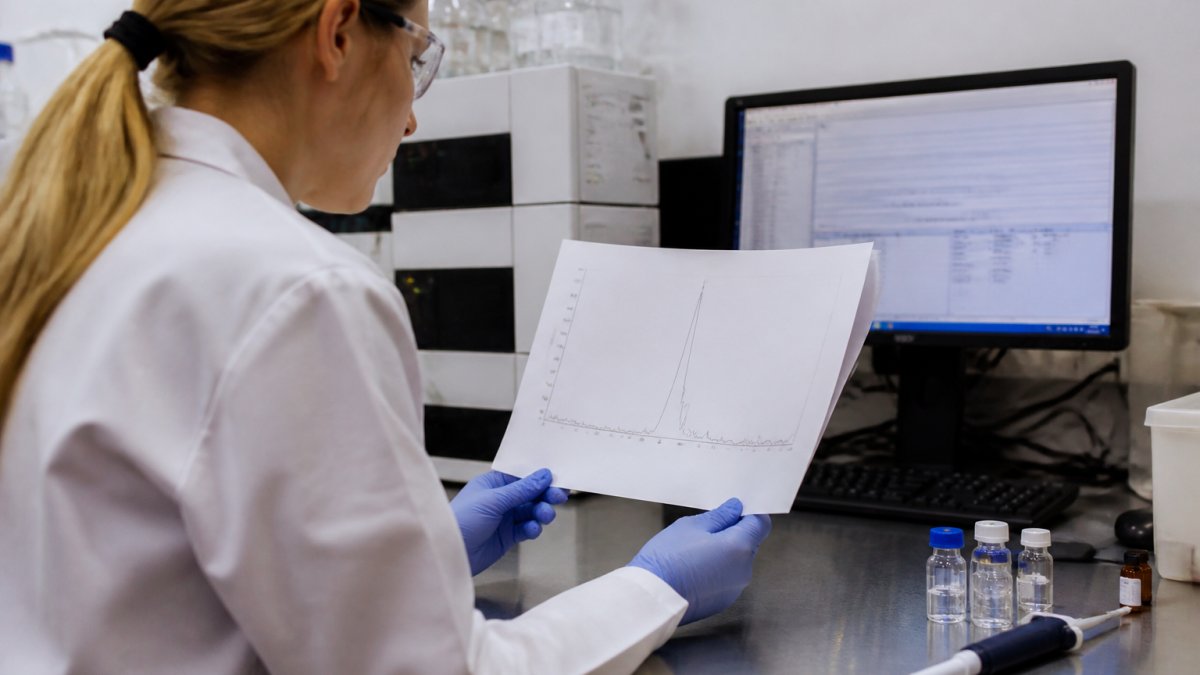
Peptide HPLC testing separates the components of a sample and produces a chromatogram, a graph of detector response over time. Each peak represents a compound that eluted from the column at a specific moment.
Reading Peak Area and Retention Time
Two numbers on a chromatogram carry most of the weight.
Retention time is when a peak appears. It helps identify what the compound likely is, because a compound's retention time depends on its interaction with the column and the mobile phase.
Peak area is the size of that peak, calculated by integrating the detector signal between the peak's start and end.
A few things to look for:
- A single dominant main peak with minimal shoulders
- Small, well-separated impurity peaks, not a messy baseline
- No broad humps that suggest degradation
A Labeled Example of Integration
Consider a simplified chromatogram with three integrated peaks:
| Peak | Retention time | Integrated area | Share of total |
|---|---|---|---|
| Main (target peptide) | 12.4 min | 9,700 units | 97.0% |
| Impurity A | 11.1 min | 200 units | 2.0% |
| Impurity B | 13.8 min | 100 units | 1.0% |
| Total | , | 10,000 units | 100% |
The reported purity here is 97.0%, because the main peak accounts for 9,700 of the 10,000 total integrated units. That is the arithmetic behind almost every "% purity" figure on a Certificate of Analysis.
What that number does not establish is just as important:
- It is relative, not absolute. The percentage describes the composition of what the detector saw, not how much peptide is in the vial.
- It depends on integration choices. Where the analyst draws the baseline and where each peak starts and ends changes the areas. A shoulder folded into the main peak inflates purity; a shoulder split out lowers it.
- It depends on the detection wavelength. Most peptide HPLC runs use UV detection near 214 nm, where the peptide backbone absorbs. Compounds that do not absorb at that wavelength are largely invisible to the method.
- It cannot separate co-eluting compounds. Two compounds with similar structure can elute at nearly the same time and hide under one peak. A single sharp peak is not proof of a single compound.
Purity Percentage vs. Net Peptide Content
Purity percentage and net peptide content are not the same thing, and mixing them up causes real errors.
Purity is the share of the target peptide among all material detected by the method. Net peptide content is how much actual peptide is in the vial, accounting for counterions, water, and salts.
So a 10 mg vial at 98% purity may contain noticeably less than 10 mg of usable peptide once you subtract those extras.
| Metric | What It Measures | Why It Matters |
|---|---|---|
| Purity percentage | Share of target peptide among integrated peaks | Signals how clean the material is by that method |
| Net peptide content | Actual peptide mass per vial | Determines your real usable amount |
| Molecular mass | Confirms peptide identity | Catches mislabeled or wrong compounds |
When HPLC Alone Is Not Enough
HPLC estimates chromatographic purity. It does not confirm identity, and it does not detect everything. Mass spectrometry supports identity by measuring molecular mass against the expected value. When a result matters, orthogonal methods, tests based on different physical principles, give you independent confirmation rather than a second read of the same signal. If a COA shows only an HPLC percentage with no identity test, treat the purity figure as one data point, not a complete picture.
Peptide Mass Spectrometry Testing for Identity
Peptide mass spectrometry testing confirms identity, not purity. It measures the molecular mass of the sample and compares it to the expected value for that peptide.
Here's why both tests are needed. HPLC tells you how much of the main component is present. Mass spectrometry tells you whether that component is actually the peptide you ordered.
A result within a tight margin of the expected mass confirms the sequence is correct.
Independent Peptide Testing: Why Third-Party Labs Matter
Independent peptide testing means a lab with no stake in the sale runs the analysis. That separation is what makes a result credible.
When a supplier tests its own material, the result is still useful, but it isn't independent. There's no external check on the method, the sample, or the reported number. Third-party testing removes that conflict.
How to Verify a Lab's Credentials
Not every lab is equal. Before you trust a COA, check the lab behind it:
- Confirm the lab is a real, named facility, not a generic "independent lab"
- Look for recognized accreditation or quality certifications
- Check that the lab reports its own method details
- Confirm the report date and that it's batch-specific
If a supplier won't name the lab, that's a red flag. Transparency about who ran the test is the baseline for trust.
Step-by-Step Verification Workflow
Here's the practical process we recommend, start to finish. Run it before any experiment that depends on purity.
- Confirm the batch number on the vial matches the COA.
- Check the test method listed for each result.
- Review the HPLC result and the chromatogram if provided.
- Review the mass spectrometry result against the expected mass.
- Note the net peptide content, not just purity.
- Verify the lab is named and credible.
- Check the test date against the batch date.
- Store the material per the COA's instructions.
Sampling, Storage, and Chain of Custody
The best test in the world is only as good as the sample it measured. Sampling, storage, and chain of custody all affect your results.
A few habits that protect your data:
- Store peptides per the COA, usually cold and protected from light.
- Avoid repeated freeze-thaw cycles, which can degrade material (pubmed.ncbi.nlm.nih.gov).
- Keep a record of when each vial was opened and how it was handled.
- If you re-test, send a representative sample, not the top of the vial.
If you ever re-test a batch yourself, compare your result to the COA. A close match builds confidence. A large gap is worth investigating before you trust the rest of the batch.
Common Mistakes and What Test Results Don't Prove
Even a perfect COA has limits. Knowing them keeps you from over-reading a result.
Common mistakes we see:
- Trusting a purity number with no named method or lab
- Assuming a single HPLC peak proves identity
- Confusing purity percentage with net peptide content
- Using a COA that doesn't match the vial's batch number
- Ignoring storage conditions after the test
And here's what test results don't prove. A COA won't tell you about endotoxin levels, sterility, or how the material behaves in your specific assay.
This is the part most guides leave out. A clean COA is a starting point for trust, not the end of it.
Verifying peptide purity takes real work, and that's exactly why it matters. Get started with Quality Peptide USA and order research-grade peptides you can actually verify.
Frequently Asked Questions
How can you verify the purity of a peptide?
Verification starts with a batch-specific certificate of analysis from an independent lab. Check that the COA includes HPLC results showing a purity percentage, mass spectrometry data confirming molecular mass, and a batch number that matches your vial. Cross-reference the testing lab's credentials and methods. If possible, send a sample to a separate third-party lab for confirmatory testing. No single test proves everything, so combining HPLC, mass spectrometry, and independent verification gives the strongest picture of peptide purity.
What does HPLC show on a peptide certificate of analysis?
HPLC separates the components in a sample and produces a chromatogram with peaks. The main peak represents your target peptide, while smaller peaks indicate impurities, degradation products, or related substances. The area percentage of the main peak is reported as purity, often greater than 95% or 98%. HPLC shows how much of the material absorbs at a given wavelength, but it does not confirm the peptide's identity. That is why mass spectrometry testing is also needed.
Can mass spectrometry confirm peptide identity?
Yes. Mass spectrometry measures the molecular mass of the peptide and compares it to the expected theoretical mass. A match confirms that the dominant molecule in the sample has the correct structure. If the observed mass differs, the peptide may be truncated, modified, or replaced with a different sequence. Mass spectrometry testing complements HPLC: HPLC tells you how pure the sample is, while mass spectrometry tells you whether the main component is actually the peptide you ordered.
Does a high HPLC purity result guarantee a peptide is safe or effective?
No. A high purity percentage means the main peak dominates the chromatogram, but it does not prove the peptide is safe, sterile, free of endotoxins, or effective for any purpose. Purity is one quality attribute among many. Research-grade peptides may still contain residual solvents, counterions, or microbial contaminants that HPLC does not detect. Always review the full COA, including endotoxin testing if relevant, and use peptides only for their intended research purposes.