


October 19, 2026 · Editorial Team
HPLC Testing for Peptides: Why It Matters
Learn why HPLC testing is essential for research peptides. Understand purity verification, quality control, and how to evaluate certificates of analysis.
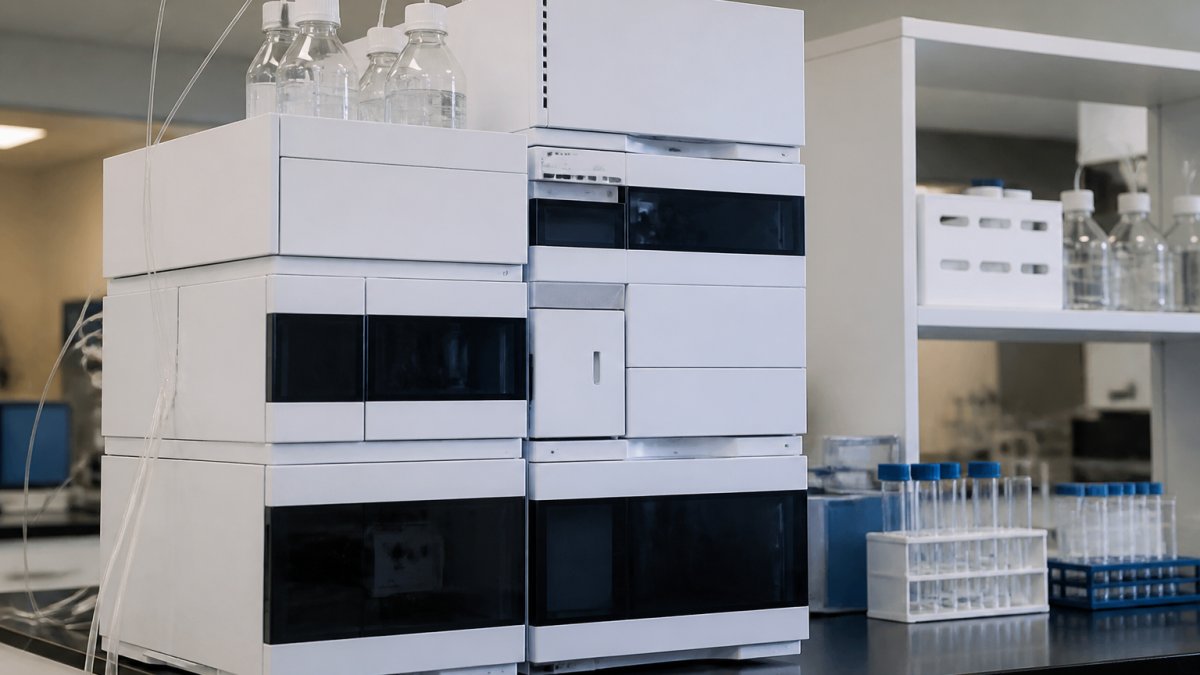
Table of Contents
- What HPLC Testing Is and Why It Matters for Research Peptides
- How to Interpret HPLC Results and Chromatograms
- Peptide Purity Testing Methods and Standards
- Peptide Identity Testing by LC-MS and Complementary Methods
- Peptide Quality Control Checklist for Batch Verification
- Evaluating Certificates of Analysis and Third-Party Verification
- Limits of HPLC Testing and When Additional Verification Is Needed
- Frequently Asked Questions
Last Updated: October 19, 2026
What HPLC Testing Is and Why It Matters for Research Peptides
HPLC testing peptides is a separation technique that verifies what's actually in your synthesized compound. High-performance liquid chromatography isolates and measures each component in a peptide sample. At Quality Peptide USA, HPLC is used as a core verification tool because it helps answer a critical question any researcher asks: is this peptide what the label says it is?
The method works by pushing a liquid sample through a column packed with tiny particles. Different molecules move through at different speeds based on their chemical properties. This separation reveals every component present, the target peptide, byproducts, unreacted starting materials, and contaminants. A detector at the end measures each peak, showing both what's there and how much of it.
Why does this matter? Because peptide synthesis is imperfect. Even under controlled conditions, side reactions occur. Incomplete coupling leaves truncated chains. Protecting groups sometimes don't remove cleanly. Without HPLC testing, you're working blind. You think you have 99% pure compound, but you might have 87%. That gap destroys reproducibility and invalidates results.
How to Interpret HPLC Results and Chromatograms
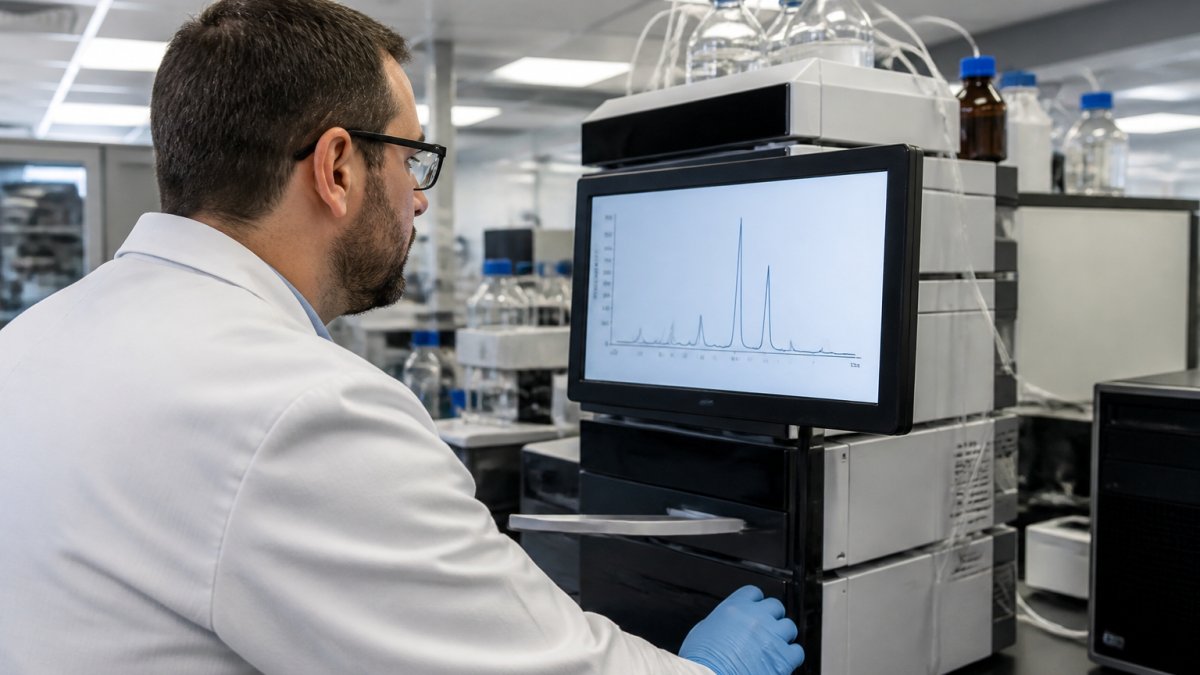
An HPLC chromatogram is a graph with time on the x-axis and detector signal on the y-axis. Each peak represents a different compound eluting from the column. Reading one correctly takes practice, but the basics are learnable, and the difference between a casual glance and a careful read is often the difference between a usable batch and a wasted experiment.
Reading Retention Time and Peak Shape
Retention time is how long a molecule takes to travel through the column, measured in minutes and plotted on the x-axis. Your target peptide has a predictable retention time based on its structure and the method used. If a peak appears at the expected time, that is consistent with your compound. If peaks show up at unexpected times, you have unknowns to account for.
Peak shape matters as much as position. A sharp, symmetric peak indicates a pure, well-resolved component. A broad, ragged peak suggests either contamination or a molecule that interacts inconsistently with the column. Asymmetric peaks, tailing or fronting, often signal problems with sample preparation, column degradation, or secondary interactions with the stationary phase.
Compare your chromatogram to a reference standard run under identical conditions. The target peak should overlap almost perfectly. Deviation means either your method is not stable or your sample differs from the reference.
Understanding Purity Percentage and Peak Area
Peak area is calculated by the HPLC software and represents the total amount of that compound. The purity percentage divides the target peak area by the sum of all peak areas, then multiplies by 100. A result of 98.5% purity means the target compound makes up 98.5% of the integrated peak area in the vial.
A worked example makes this concrete. Suppose the software reports a target peak area of 9,850 units and the sum of all integrated peaks is 10,000 units. Purity is 9,850 ÷ 10,000 × 100 = 98.5%. If a single impurity peak contributes 100 units and nine minor peaks contribute 50 units total, the same 98.5% number describes two very different samples. That is why the chromatogram, not the percentage, is the primary document.
This number is only meaningful if all peaks are detected equally. HPLC detectors respond differently to different compounds. A molecule with a chromophore (a light-absorbing group) shows a bigger signal than one without, even at the same concentration. This is why certificates of analysis must specify the detection method: UV absorbance at a specific wavelength, refractive index, or mass spectrometry.
Integration, Baseline, and the Parameters Behind the Number
The purity number is only as good as the integration that produced it. Integration is the software step that draws a baseline under each peak and calculates its area. Small changes in baseline selection, peak width, slope sensitivity, and threshold settings can move a reported purity by a percentage point or more. A supplier who reports 99% purity without disclosing integration parameters is asking you to trust a number you cannot audit.
When you review a chromatogram, look for these features:
- Baseline stability. A drifting or noisy baseline makes integration unreliable and can inflate or deflate the target peak area.
- Shoulders. A shoulder on the main peak is an unresolved impurity. It may be integrated as part of the main peak, which hides it from the purity calculation.
- Peaks below the threshold. Small peaks that fall below the integration threshold are excluded from the purity calculation entirely. A method that ignores peaks below 0.1% will report a higher purity than one that counts them.
- System peaks. Solvent fronts and injection artifacts can appear as peaks and should be identified, not counted as impurities.
Reading the Report as a Whole
A complete HPLC report should include the method (column, mobile phase, gradient, detection wavelength), the injection volume and sample concentration, the retention time of the main peak, the integration parameters, and the full peak table with areas and area percentages. If any of these are missing, the purity number is not verifiable. Ask for the full report, not just the headline percentage.
Peptide Purity Testing Methods and Standards
HPLC testing peptides is the most common method, but it's not the only one. Different techniques measure different properties and catch different problems.
Reverse-phase HPLC (RP-HPLC) is the industry standard for peptides. The column is hydrophobic, so hydrophobic peptides stick longer than hydrophilic ones. This separation works well for most research peptides and is fast, usually 15 to 30 minutes per run.
Size exclusion chromatography (SEC) separates by molecular weight. Larger molecules elute first; smaller ones later. SEC is useful for detecting aggregates or degradation products that have different sizes than the target. It's less precise for purity measurement but excellent for detecting structural problems.
Ion-exchange chromatography separates by charge. Peptides with different net charges elute at different salt concentrations. This method is particularly sensitive to post-translational modifications or chemical modifications that change charge.
Most commercial peptide suppliers use RP-HPLC as their primary method because it's reliable, fast, and reproducible. Quality Peptide USA employs RP-HPLC for all standard peptides.
Peptide Identity Testing by LC-MS and Complementary Methods
HPLC tells you about purity and separation, but it doesn't confirm identity with certainty. Two different peptides could have similar retention times and look like a single peak. This is where mass spectrometry comes in.
Liquid chromatography-mass spectrometry (LC-MS) combines HPLC separation with mass detection. As each peak elutes from the column, it enters a mass spectrometer that measures the exact molecular weight. For a peptide, this is definitive proof of identity. If your 20-amino-acid peptide has a calculated mass of 2,347 Da and the mass spectrometer reads 2,347 Da, you've confirmed it's the right molecule.
LC-MS is more expensive than HPLC alone and requires specialized equipment and expertise. But for critical research, it's worth the cost. It answers the question HPLC cannot: is this actually the peptide I ordered?
Other complementary methods include:
- Amino acid analysis breaks the peptide into individual amino acids and quantifies them. It confirms the amino acid composition matches your design.
- N-terminal sequencing (Edman degradation) identifies the first few amino acids. It catches truncated or modified peptides.
- Peptide mapping uses proteolytic digestion to break the peptide into smaller fragments, then analyzes those fragments. It reveals structural details.
For most research applications, HPLC + mass spectrometry covers identity and purity comprehensively. For specialized work, especially anything involving post-translational modifications or non-standard amino acids, additional methods may be necessary.
Peptide Quality Control Checklist for Batch Verification
When you receive a peptide batch, verify these items before using it in experiments:
- Certificate of Analysis (CoA) is present and dated within the last 6 months
- Purity percentage is listed and meets your requirement (typically 95%+ minimum)
- HPLC method is specified (reverse-phase, ion-exchange, etc.)
- Detection wavelength or method is documented
- Retention time range is provided for reference
- Molecular weight or mass spectrometry data is included if available
- Chromatogram image is attached or accessible
- Storage instructions are clear (temperature, light exposure, solvent)
- Lot number and synthesis date are visible on the vial label
- Vial integrity is intact, no cracks, leaks, or discoloration
If any of these are missing, contact your supplier. Quality Peptide USA makes chromatograms available upon request. A complete CoA is non-negotiable. If a supplier won't provide it, that's a red flag.
Evaluating Certificates of Analysis and Third-Party Verification
A certificate of analysis is your proof that testing actually happened. But not all CoAs are created equal. Here's how to read one critically.
Look for these red flags:
- No chromatogram attached. The supplier tested something, but you can't see what. Insist on the actual HPLC trace.
- Purity listed without a method. If the CoA doesn't specify reverse-phase HPLC at 214 nm UV, or whatever method was used, the number is meaningless.
- No retention time data. This prevents you from comparing your results to theirs if you re-test.
- Vague impurity descriptions. "Other impurities <2%" doesn't tell you what those impurities are. A good CoA lists significant peaks by retention time and approximate identity.
- No date or lot number matching the vial. Make sure the CoA actually describes the batch you received, not a representative batch from months ago.
Third-party verification adds credibility. When an independent lab tests and certifies a peptide, there's no financial incentive to inflate purity numbers. Quality Peptide USA uses independent laboratories to verify every batch.
Ask your supplier: Who ran the HPLC? Is it your in-house lab or an independent third party? If it's in-house, ask for their accreditation (ISO 17025 is the standard for analytical labs). If it's third-party, request the lab's name and credentials.
Limits of HPLC Testing and When Additional Verification Is Needed
HPLC is powerful, but it has boundaries. Understanding them keeps you from over-trusting a single number and from treating a purity result as something it is not.
What HPLC Cannot Establish
HPLC separates and quantifies what absorbs at the detection wavelength. It does not establish identity, safety, sterility, or regulatory status. Specifically, HPLC cannot detect:
- Endotoxins. These bacterial contaminants do not show up on HPLC. They require a separate test, typically a Limulus amebocyte lysate (LAL) assay. If your research involves cell culture or in vivo work, endotoxin testing is critical.
- Sterility. HPLC measures chemical purity, not microbial contamination. Sterile filtration and microbiological testing are separate requirements.
- Water content. HPLC measures dissolved solids. If your peptide is hygroscopic and absorbs moisture, the purity number may not reflect actual dry mass. Karl Fischer titration is the standard method for water content.
- Counterion content. Many peptides are supplied as acetate or trifluoroacetate (TFA) salts. The counterion contributes mass but may not appear as a distinct peak, so a purity figure calculated by peak area can overstate the peptide content of the vial.
- Aggregation state. If peptides have clumped together, HPLC may not detect it, depending on the method. Size exclusion chromatography or dynamic light scattering catches aggregates.
- Oxidation of sensitive amino acids. Methionine and cysteine oxidize easily. HPLC might show a peak for both oxidized and native forms, but it will not tell you whether oxidation happened during synthesis or during storage.
Co-Elution: The Limit That Matters Most
The most important limitation is co-elution. Two different compounds can have nearly identical retention times under a given method and appear as a single, sharp, symmetric peak. The purity calculation will count that peak as one component, and the reported purity will be high even though the sample contains a mixture. This is not a rare edge case; it is a structural feature of any one-dimensional separation method.
Co-elution is why chromatographic purity alone does not conclusively establish molecular identity. A 99% pure peak is 99% of the integrated area, not 99% of the molecules being the peptide you ordered. The only way to close that gap is an orthogonal identity method, most commonly mass spectrometry.
Sample Handling and Storage Effects
Results are also shaped by what happens before and after the run. Repeated freeze-thaw cycles, exposure to light, improper solvent choice, and adsorption to plastic can all change the chromatogram. A sample that was pure at release can show degradation peaks months later. When you compare a certificate of analysis to a re-test, confirm that storage and preparation conditions match; otherwise you are comparing two different experiments.
When HPLC Alone Is Not Enough
- Cell-based assays. If you are testing a bioactive peptide, verify biological activity in cells. HPLC confirms chemical structure; bioassays confirm function.
- Animal studies. Endotoxin and sterility become non-negotiable. Add LAL and microbial testing to your verification.
- Pharmaceutical applications. Regulatory standards require multiple orthogonal methods. HPLC is necessary but insufficient.
- Modified or non-standard peptides. Post-translational modifications, D-amino acids, or non-standard side chains may require LC-MS or specialized methods for confirmation.
Safety and Intended-Use Boundaries
HPLC results do not establish that a peptide is safe, sterile, free of endotoxin, or approved for any human or veterinary use. A certificate of analysis is an analytical document, not a regulatory approval. Research-grade peptides are intended for laboratory research only, and a high purity number should never be read as a safety determination. If a supplier implies otherwise, treat that as a warning sign about how they describe their products.
Frequently Asked Questions
Why do we do HPLC testing on research peptides?
HPLC testing separates peptide components to measure purity, identify impurities, and confirm that a synthesized peptide matches its expected composition. For research applications, this verification is critical because even small contaminants or structural variations can affect experimental outcomes. HPLC provides reproducible, quantifiable data that supports regulatory compliance and ensures batch-to-batch consistency, which is especially important in preclinical studies where reagent reliability directly impacts result validity.
What does an HPLC purity percentage tell you about a peptide?
The purity percentage represents the proportion of the target compound relative to all detected substances in the sample. A reading of 99% purity means that 99% of the material is the intended peptide and 1% consists of impurities, byproducts, or degradation products. This metric helps researchers assess whether a batch meets their experimental requirements. However, purity percentage alone does not identify what the impurities are or whether they might interfere with your specific research application, that is why examining the full chromatogram and complementary testing methods are equally important.
Can HPLC confirm a peptide's identity?
HPLC can support identity confirmation by showing that the retention time and peak pattern match a known reference standard, but it cannot definitively prove chemical structure on its own. HPLC separates and quantifies compounds, but mass spectrometry (LC-MS) is the gold standard for structural verification because it measures molecular weight and fragmentation patterns. Many laboratories use HPLC for purity and consistency verification and pair it with mass spectrometry or other complementary methods for definitive identity confirmation, especially for research applications where accuracy is critical.
What are the main limitations of HPLC testing for peptides?
HPLC cannot detect non-chromophoric impurities that do not absorb UV light, and it does not provide structural information about what contaminants are present. It also cannot reliably detect certain classes of contamination, such as endotoxins or microbial material, which require separate testing methods. Additionally, HPLC results depend heavily on method validation, column condition, and mobile phase composition, different labs using different methods may report different purity values for the same sample. This is why independent, third-party testing with validated methods and certificates of analysis are important for research-grade peptides.