

October 21, 2026 · Editorial Team
Buy cGMP Compliant Peptides: A Research Guide
Learn how to purchase cGMP compliant peptides for research. Verify purity, certificates of analysis, and domestic sourcing for your laboratory.
Table of Contents
- Understanding cGMP Compliance in Peptide Manufacturing
- What to Look for in cGMP-Compliant Peptide Suppliers
- How to Verify Peptide Purity and Authenticity
- Reading and Requesting a Peptide Certificate of Analysis
- Research Peptide Shipping and Handling Best Practices
- Peptide Storage for Long-Term Stability and Integrity
- Evaluating Cost vs. Quality When Purchasing Peptides
- Frequently Asked Questions
Last Updated: October 21, 2026
Understanding cGMP Compliance in Peptide Manufacturing
Two ideas get mashed together in this query. A continuous glucose monitor (CGM) is a wearable medical device that measures interstitial glucose and transmits readings to a receiver or app. cGMP, current good manufacturing practice, is a manufacturing quality framework. A peptide is not a CGM, and a CGM cannot validate a peptide's identity, purity, or safety. If you want CGM supplies, you need a device vendor; if you want cGMP-compliant peptides, read on. (Source: Title 21 of the Code of Federal Regulations)
What cGMP actually requires
In the U.S., cGMP for drugs is codified in Title 21 of the Code of Federal Regulations, primarily Parts 210 and 211, covering facilities, equipment, production and process controls, laboratory controls, packaging and labeling, and batch records and deviation handling.
For a peptide operation, cGMP compliance means documented synthesis and purification, validated analytical methods, calibrated equipment, environmental monitoring where required, a quality unit with authority to release or reject batches, stability programs, and a complaint and recall system.
The distinction most buyers miss
Three claims a supplier can truthfully make are not interchangeable:
- Facility registration. The establishment is listed with the FDA, an inventory of who makes what and where, not a finding of compliance or proof of inspection.
- Facility cGMP compliance. The site operates under a cGMP quality system and has been inspected against it. This is the strongest claim and should come with inspectable evidence.
- Product testing. A specific batch was analyzed by HPLC, mass spectrometry, or other methods and produced a certificate of analysis. This tells you about that batch, not the facility's systems.
A supplier can have strong batch testing and weak facility systems, or the reverse. Serious buyers ask for evidence of both.
How to verify, step by step
- Ask for the FEI number. The FDA Establishment Identifier ties to a registered facility; a supplier that won't provide one is asking you to take its claim on faith.
- Check the registration status. FDA's public establishment database confirms whether a facility is registered and for what operations.
- Ask what was inspected and when. A cGMP claim needs an inspection history, not a logo, request the date and outcome of the most recent inspection and any Form 483 observations.
- Separate the manufacturing site from the brand. Many storefronts are marketers; ask which legal entity synthesizes the peptide and where, then verify that entity, not the website.
- Cross-check the COA against the facility. The lab named on the certificate should be independent of the manufacturer, and the batch number should match the vial.
Why this matters for reproducibility
A research protocol is only as good as the material it runs on.
For buyers comparing domestic suppliers, the practical test is simple: request the FEI number, the manufacturing entity, the inspection history, and a batch-specific COA in one message. Suppliers with real systems answer quickly because the documents already exist; those without them stall, hedge, or call the information proprietary.
What to Look for in cGMP-Compliant Peptide Suppliers
Most supplier guides hand you a checklist of adjectives, reputable, transparent, certified, and stop there. A useful evaluation scores a supplier on evidence you can inspect, starting with honesty about what you are buying.
First, know which category the product falls into
Peptides reach buyers through three channels with different rules:
- FDA-approved medicines. A small number of peptide drugs are approved for specific indications and dispensed by prescription through licensed pharmacies, with reviewed labeling and post-market surveillance.
- Compounded drugs. A licensed compounding pharmacy may prepare a peptide under a prescription when an approved product doesn't meet a patient's needs. Compounding operates under a separate framework (Sections 503A and 503B of the Federal Food, Drug, and Cosmetic Act) and is not the same as manufacturing an approved drug (the FDA).
- Research-use-only (RUO) products. Sold for laboratory investigation, labeled "not for human or veterinary use," and not medicines. Most of what a peptide storefront sells falls here.
Establish this distinction before comparing suppliers. An RUO vial is not a treatment, and a supplier marketing RUO peptides with dosing advice or implied medical benefits is blurring a line the FDA cares about. For clinical questions, including glucose monitoring or metabolic health, see a licensed clinician, not a product page.
A verification framework you can score
Score every supplier on the same five criteria and record the results. The point is comparability, not a single pass/fail.
| Criterion | What to request | What a strong answer looks like |
|---|---|---|
| Manufacturing disclosure | Legal entity, FEI number, synthesis site | A named facility you can look up, not a brand name |
| Batch traceability | Batch number linking vial to COA to synthesis record | The number on the vial matches the certificate |
| Independent testing | COA from a lab unaffiliated with the manufacturer | Raw HPLC chromatogram and mass spec data, not just a purity percentage |
| Intended-use labeling | Clear RUO designation and handling instructions | No dosing guidance, no medical claims, no implied human use |
| Quality system evidence | Inspection history, deviation and recall process | Specific dates and outcomes, not a certification logo |
Questions that separate real systems from marketing
- "Who synthesized this batch, and what is their FEI number?" Marketers resell; manufacturers can name their site.
- "Can you send the full chromatogram and mass spectrum for this lot?" A summary percentage is easy to type; raw data is harder to fake.
- "Which laboratory ran the test, and is it independent of your facility?" In-house-only testing is not independent verification.
- "What is your deviation and out-of-specification process?" Suppliers with a quality unit answer in specifics; resellers change the subject.
- "How is the product labeled, and what use is it intended for?" A clear RUO statement shows a supplier that understands its regulatory position.
Domestic sourcing: what it does and does not guarantee
U.S.-based synthesis shortens transit time, reduces temperature-excursion risk, and puts accountability within reach of domestic law and inspection. But "made in the USA" is a location claim, not a quality claim, a domestic facility can run a weak quality system and an overseas facility a strong one. Treat domestic sourcing as one weighted factor, not a substitute for the framework above.
Red flags worth walking away from
- Purity claims with no batch-specific certificate behind them.
- Medical or dosing claims on a research-use product.
- Reluctance to name the manufacturing entity or provide an FEI number.
- COAs that list no laboratory, no method, or no test date.
- Prices far below the market with no explanation of what was cut to get there.
A supplier that clears this framework is not automatically the right choice for every experiment, but it has given you the evidence to decide for yourself, more than a table of adjectives ever will.
How to Verify Peptide Purity and Authenticity
Purity claims without documentation are marketing noise. The only way to verify authenticity is independent laboratory testing, specifically high-performance liquid chromatography (HPLC), which separates peptide components and quantifies your target compound against impurities.
Demand the actual HPLC chromatogram, not just a summary percentage.
Be skeptical of 99%+ purity claims without documentation, not impossible, but it requires sophisticated purification and rigorous QC. Most research-grade peptides fall in the 95-99% range depending on complexity.
Mislabeling is a real risk, especially with international suppliers: a vial may contain a different compound or the wrong concentration. When you purchase cgm compliant peptides in the USA from a domestic manufacturer with proper documentation, you can trace that vial to its synthesis date, equipment, and exact testing results.
Reading and Requesting a Peptide Certificate of Analysis
A certificate of analysis (COA) is your proof of what you received. It should include peptide identity, purity percentage, concentration, testing method, date of analysis, and the testing laboratory.
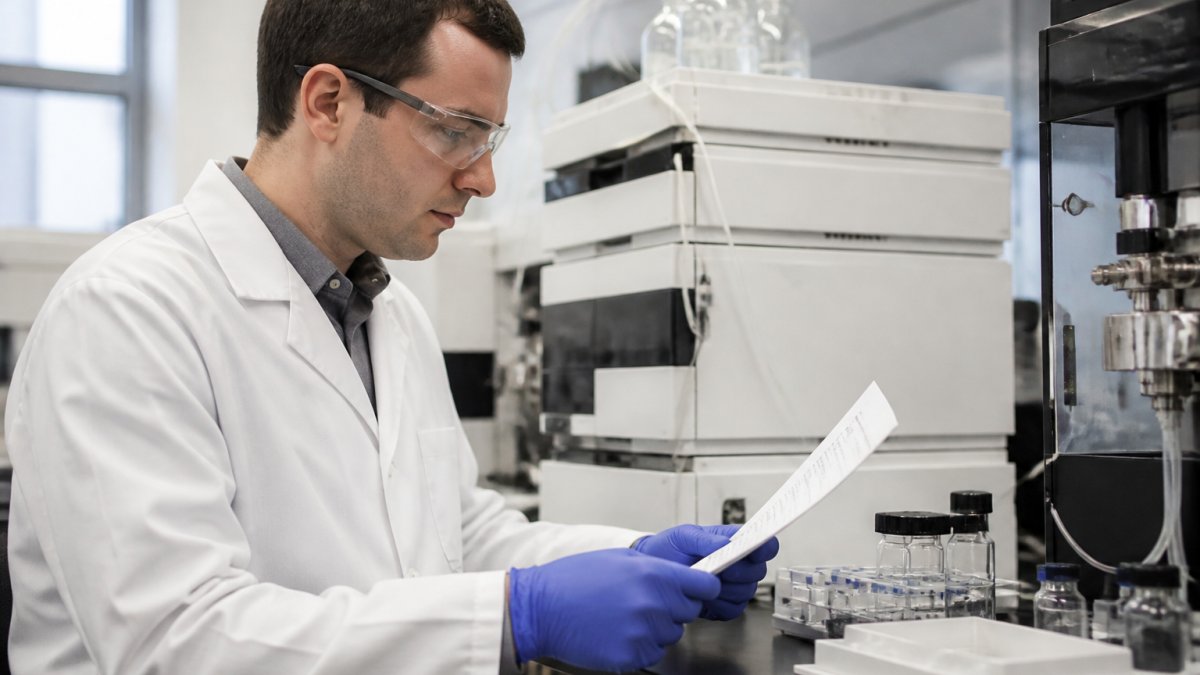
Request COAs before you order, not after: it confirms independent testing is in place and lets you compare results across suppliers.
Batch-specific COAs are always better than "typical" results because they reflect exactly what you're receiving; typical results don't guarantee your vial meets those specs.
Research Peptide Shipping and Handling Best Practices
Shipping directly affects peptide stability. Temperature control in transit is critical, most peptides degrade in heat and some require cold chain management.
Request tracking and a signature on delivery for accountability. Ask about the damage replacement policy: if a peptide arrives compromised, will they replace it at no cost?
When you purchase cgm compliant peptides, verify discreet packaging with a generic return address, standard practice for research compounds that protects your privacy.
Peptide Storage for Long-Term Stability and Integrity
Storage after delivery determines whether peptides stay viable for months or degrade within weeks.
Use airtight, opaque containers, glass vials with PTFE-lined caps are ideal. Light degrades many peptides, so amber or opaque vials beat clear ones.
For regular use, keep a working aliquot at 4°C and the bulk supply frozen to minimize freeze-thaw cycles on your main stock.
Storage temperature stability matters as much as shipping. A freezer holding a consistent -20°C is fine; one cycling between -15°C and -25°C degrades peptides faster.
Evaluating Cost vs. Quality When Purchasing Peptides
Price differences between suppliers reflect real differences in quality, testing, and supply chain reliability.
The true cost isn't the per-vial price but the per-usable-unit cost after purity and stability.
Domestic suppliers typically cost more because they maintain higher standards, pay U.S. wages, and operate under stricter regulatory oversight.
Volume discounts are common but shouldn't come at quality's expense, steep bulk discounts can mean cut corners.
Weigh the hidden costs of unreliable suppliers: failed experiments, repeated orders, communication delays, and research delays.
Purchasing research-grade peptides requires more than finding the lowest price. Our commitment to transparent batch documentation and fast domestic shipping means you can focus on your science while we handle the manufacturing rigor. Shop our catalog today and experience the difference that true domestic compliance makes.
Frequently Asked Questions
What does cGMP compliance mean for a peptide supplier?
Current Good Manufacturing Practice (cGMP) is a regulatory standard that ensures pharmaceutical and research-grade products are manufactured consistently and safely. For peptide suppliers, cGMP compliance means the facility follows FDA-established guidelines for manufacturing processes, quality control, equipment maintenance, personnel training, and documentation. A cGMP-compliant peptide supplier maintains batch records, conducts regular testing, and implements contamination controls. This standard is critical for research applications because it guarantees that every vial meets documented specifications and that manufacturing variations are controlled and traceable.
How can I verify a research peptide's purity?
Request an independent third-party certificate of analysis (COA) from your supplier. The COA should show HPLC (high-performance liquid chromatography) results confirming purity percentage, typically 99% or higher for research-grade peptides. Verify that the testing was performed by an independent laboratory, not the manufacturer itself. Ask your supplier for batch-specific COAs rather than general product sheets. If you have concerns, you can send samples to your own analytical laboratory for re-testing. Reputable suppliers provide COAs without hesitation and can explain their testing methodology.
How should research peptides be stored after delivery?
Store peptides in a freezer at -20°C or colder immediately upon receipt. Keep them in airtight, light-protected containers away from moisture and humidity. Many peptides are sensitive to freeze-thaw cycles, so divide bulk orders into smaller aliquots if you plan multiple uses. Maintain a storage log documenting receipt date, storage temperature, and any handling. Check your supplier's specific storage instructions, as some peptides may require -80°C or desiccant packs. Proper storage preserves purity and prevents degradation that could compromise your research results.
What documentation should I request when purchasing research peptides?
Request a certificate of analysis (COA) showing HPLC purity data, molecular weight confirmation, and batch number. Ask for batch records that trace manufacturing date, lot traceability, and quality control results. Confirm the supplier's cGMP status. Request information about endotoxin testing if your research involves sensitive biological systems. Get written confirmation of the peptide's origin (domestic synthesis and packaging), shipping method, and handling procedures. Documentation protects your research integrity and provides evidence if results are questioned later.