

October 25, 2026 · Editorial Team
7 Steps to Commission Independent HPLC Testing for Peptides
Learn how independent HPLC testing for peptides verifies purity and quality. Discover the 7 steps to select labs and interpret results.
Last Updated: October 25, 2026
Quick Summary
Independent HPLC testing for peptides verifies actual purity and identifies impurities by using a third-party laboratory with no financial stake in the supplier. This separation-based chemistry test measures what percentage of your sample is the target peptide and what else is present, catching discrepancies between supplier claims and reality.
- Independent labs have no financial interest in suppliers and report unbiased results based on chromatographic analysis.
- HPLC testing measures purity percentage and impurity profiles but does not test sterility, endotoxin levels, or biological activity.
- Select labs by verifying independence, checking accreditation scope for peptide methods, and confirming reversed-phase HPLC capability on C18 columns.
- Submit 5-10 mg samples with complete chain of custody documentation and test multiple vials from large orders to confirm batch consistency.
- Read the chromatogram and peak integration on the COA to verify the purity number and identify co-eluting peaks that reduce accuracy.
Table of Contents
- Why Independent HPLC Testing Matters for Research Peptides
- Understanding What HPLC Testing Measures in Peptides
- How to Select a Third-Party Peptide Testing Laboratory
- Step-by-Step: Commissioning Your Independent HPLC Test
- How to Read a Peptide COA and Interpret Results
- Peptide Identity Testing by Mass Spectrometry
- HPLC Testing Cost for Peptides and Turnaround Times
- What HPLC Purity Does Not Establish
- Frequently Asked Questions
Why Independent HPLC Testing Matters for Research Peptides
When you order research peptides, you're betting your experiment on purity, which is why independent hplc testing for peptides is essential. A supplier claims 99% purity. But what does that actually mean?
Independent HPLC testing for peptides is the only way to know what you actually have. It's not about trusting the supplier's word. It's about verification. A third-party lab runs the test. They have no stake in selling you anything. They report what they find.
This matters because supplier testing and independent testing often disagree. The gap can be small, a few percentage points. Or it can be massive. Either way, you need to know before you inject, before you incubate, before you spend months chasing results that were never real.
Independent testing catches three things supplier claims can't:
- Actual purity level (not marketing language)
- Specific impurities and degradation products
- Whether the peptide identity matches what's on the label
Understanding What HPLC Testing Measures in Peptides
High-performance liquid chromatography separates peptide components by pushing them through a column under pressure. Different molecules stick to the column for different lengths of time. That difference is how HPLC tells them apart.
Chromatographic purity is what HPLC actually measures. It's the percentage of the sample that is your target peptide, separated by time on the column. The instrument detects each component as it exits. The detector draws a line, a chromatogram.
HPLC testing for peptides answers specific questions:
- What percentage is the target peptide? (purity percentage)
- What else is in the vial? (impurity profile)
- Are any impurities above acceptable limits? (related substances)
- Has the peptide degraded or oxidized? (degradation products)
The test does NOT answer other questions. It doesn't tell you if the peptide is sterile. It doesn't measure endotoxin levels. It doesn't confirm biological activity. HPLC is a chemistry test, not a biology test. It separates and counts molecules. It doesn't test what those molecules do.
This distinction matters. A peptide can be 99% pure by HPLC and still fail your assay if it's contaminated with bacteria or endotoxin. Purity and safety are not the same thing.
How to Select a Third-Party Peptide Testing Laboratory
Not every lab is independent, and not every independent lab is competent for peptide work. The two failure modes look different: a supplier-owned lab may soften results, while a generalist lab may run the right instrument with the wrong method. You need to screen for both.
Verify independence before you verify competence
Independence is a structural question, not a vibe. Ask for answers in writing and keep them with your records.
- Ownership and conflicts. Ask who owns the lab and whether it, or any parent company, has a financial interest in a peptide supplier, distributor, or contract manufacturer. A lab that also sells peptides has an incentive to make its own product look good.
- Client mix. Ask what share of the lab's peptide work comes from suppliers versus researchers, universities, and contract research organizations. A lab that mostly serves suppliers may be calibrated to supplier specifications rather than yours.
- Willingness to test competitors. Ask directly: "Will you test a sample from any supplier, including one you have worked with?" A hesitation or a policy against it is a signal. An independent lab has no reason to refuse.
- Blinding. Ask whether the analyst sees the supplier name and lot number, or only a sample ID. Blinded analysis reduces the chance that expectations shape integration decisions on ambiguous peaks.
Check accreditation scope, not just the certificate
A lab may display an accreditation logo while the specific peptide method you need sits outside the accredited scope. Accreditation is granted per method, per matrix, and per analyte, so the logo alone proves little.
- Look up the scope. Most accrediting bodies publish a searchable directory of accredited laboratories and their approved methods. Find the lab in that directory and confirm that reversed-phase HPLC purity testing of peptides, and mass spectrometry identity confirmation if you need it, appear in the scope.
- Check the standard. Confirm the accreditation is to a recognized analytical standard rather than an internal one. The scope document should name the standard and the methods.
- Ask about method validation. For each method the lab will run, ask whether it has been validated for peptides specifically: accuracy, precision, linearity, limit of detection, limit of quantitation, and robustness. A method validated for small-molecule drugs is not automatically valid for a 3-5 kDa peptide with hydrophobic residues.
- Ask about system suitability. Good labs run system suitability checks before a batch: resolution between critical peaks, tailing factor, and repeatability of replicate injections. Ask what their acceptance criteria are.
Confirm instrument capability and method fit
HPLC is a family of methods, not a single test. The column chemistry, mobile phase, gradient, detector wavelength, and column temperature all change what you see.
- Column and chemistry. For most peptides, reversed-phase HPLC on a C18 column with a water/acetonitrile gradient and trifluoroacetic acid as an ion-pairing agent is standard. Ask which column dimensions and particle size they use; smaller particles and shorter columns (UPLC-type) give faster runs and sharper peaks but require the right instrument.
- Detector. UV detection at 214 nm is common for the peptide backbone; 220 nm and 280 nm are also used. Ask which wavelength they report and whether they run a diode-array detector to check peak purity.
- Identity confirmation. If you need to confirm the peptide is what the label says, ask whether they run LC-MS or MALDI-MS and how they compare the observed mass to the expected mass. A mass error outside a few parts per million to a few hundred parts per million, depending on the instrument, warrants a question.
- Orthogonal methods. Ask whether they offer size-exclusion chromatography for aggregation and ion-exchange chromatography for charge variants. A lab that only runs one method will miss problems that method cannot see.
Ask the questions that separate a quote from a partner
A short, specific question set tells you more than a brochure:
- Which accreditation body accredits you, and what is the exact scope entry for peptide HPLC purity?
- Has the method been validated for peptides, and can you share the validation summary?
- What are your system suitability criteria, and do you report them on the certificate?
- Do you blind samples, and do you accept samples from any supplier?
- What is your policy on co-eluting peaks and how do you report them?
- Who signs the certificate, and what is that person's role?
- Can you provide a redacted example certificate for a peptide of similar size and hydrophobicity?
A lab that answers these clearly and in writing is a better bet than one that answers with a sales deck. Competence is demonstrated by specificity, not by size.
Step-by-Step: Commissioning Your Independent HPLC Test
Preparing and Submitting Your Sample
Start by deciding what you're testing. Lab Testing You Can Verify outlines the full range of testing services available, from HPLC purity to endotoxin and heavy-metals analysis. One vial? Multiple batches? The entire lot?
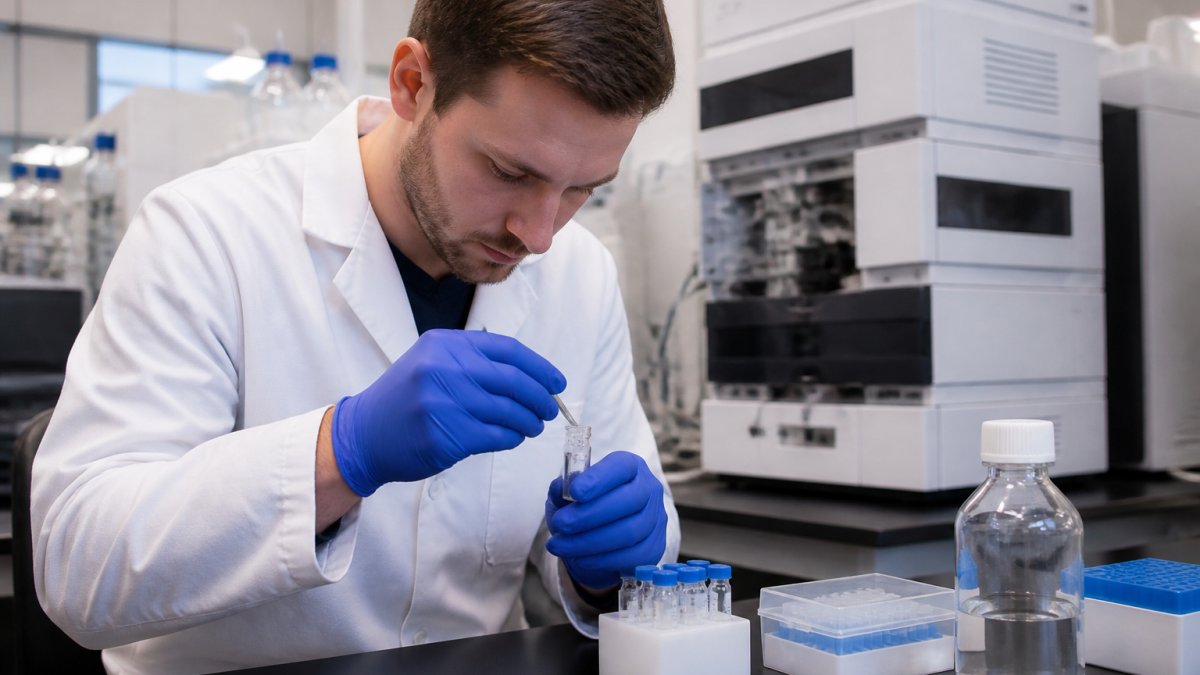
Prepare the sample according to the lab's instructions. Most labs ask for:
- At least 5-10 mg of peptide (enough for multiple runs)
- Sealed in a clean, labeled vial
- Stored at room temperature unless the lab specifies otherwise
- Documentation of storage conditions (has it been frozen? exposed to light?)
Label the vial clearly. Use the lot number from your supplier. Include the date you received it. Write the supplier name. This information goes on the chain of custody form.
Contact the lab before sending anything. Confirm their address. Ask about shipping requirements. Some labs want samples overnight. Others accept standard mail. Ask if they need a purchase order or if you can pay after results.
Pack the sample securely. Use a padded mailer. Include a packing slip with:
- Your name and contact information
- The peptide name and lot number
- Supplier name
- Date received
- Any storage or handling notes
- What tests you want (HPLC purity, identity, impurity profile)
Keep a copy of everything you send. You'll need it to match results to the sample.
Chain of Custody and Representative Sampling
Chain of custody is a written record of who handled the sample and when. It matters because it proves the sample tested is the sample you received.
Here's how it works: You document receipt (date, time, condition). You document shipment to the lab (carrier, tracking number). The lab documents receipt (date, time, condition).
If anything breaks the chain, if the sample sits unrefrigerated for a week, if it's handled by someone not documented, the results become questionable.
Representative sampling means the vial you test actually represents the entire batch. If you ordered 100 vials, testing just one assumes all 100 are identical. That's usually true.
Best practice: test one vial from the beginning of the shipment, one from the middle, one from the end. This catches variation across the lot.
For large orders, ask your supplier how many vials you received and how they were packaged. Were they all made in one synthesis run?
How to Read a Peptide COA and Interpret Results
A Certificate of Analysis is the lab's report. It shows what they tested, how they tested it, and what they found.
The COA has standard sections:
- Sample identification: lot number, supplier, date received
- Test methods: which HPLC method, which detector, which column
- Chromatogram: the actual graph showing peaks
- Purity result: the percentage (e.g., 98.7% by HPLC)
- Impurity profile: list of peaks, their percentages, their identity if known
- Pass/fail: whether it meets the specification you requested
The first thing to check: is the lot number correct? Does the COA match the vial you tested? Mistakes happen. Verify this before trusting anything else.
Chromatographic Purity and Peak Integration
The chromatogram is the key. It's a graph with time on the X-axis and signal intensity on the Y-axis. Each peak is a different component.
The biggest peak is almost always your target peptide. The lab uses software to calculate the area under each peak. Peak area is proportional to the amount of that component.
This process is called peak integration. The software draws a line at the baseline and calculates area. Different software can give slightly different results if peaks overlap. Good labs use validated methods.
Look at the chromatogram itself. Does the target peak stand alone? Or does it overlap with other peaks? Overlap makes integration harder and less reliable. A clean, separated peak is better.
The purity number is only as good as the integration. If two peaks overlap, the lab might report 99% purity when the truth is 97% + 2% of something else.
Understanding Impurity Profiles and Degradation Products
The impurity profile lists every peak except the target. How to Verify Peptide Purity: A Lab Guide provides a detailed walkthrough of COA interpretation and what each component means for your research. It shows:
- Retention time (when it came off the column)
- Peak area percentage
- Identity (if the lab determined it)
Common impurities in peptides:
- Deletion peptides: missing one or more amino acids (usually smaller, earlier retention time)
- Oxidation products: oxidized methionine or tryptophan (similar retention time, slightly different)
- Dimerization: two peptides stuck together (larger, later retention time)
- Acetyl residue: from synthesis (slightly earlier retention time)
- Water or solvent: from the storage solution (very early, often not reported)
Degradation products form over time. Heat, light, and humidity cause breakdown. If your peptide was stored poorly, you'll see more degradation products.
A clean peptide shows one major peak (>95%) and minor peaks (<1% each). A degraded peptide shows multiple peaks of similar size. That's a red flag.
Ask yourself: Are the impurities expected? Acetyl or deletion peptides are normal synthesis byproducts. Oxidation is normal if the peptide contains methionine. Unexpected impurities, peaks the lab can't identify, suggest contamination or handling problems.
The spec you request matters. If you specify "95% purity minimum," a 96% result passes. If you specify "no single impurity >2%," you're checking the profile, not just the total. Different specs catch different problems.
How to Verify Peptide Purity: A Lab Guide provides a detailed walkthrough of COA interpretation and what each component means for your research.
Peptide Identity Testing by Mass Spectrometry
HPLC tells you purity. Mass spectrometry tells you identity. They answer different questions.
Mass spectrometry measures molecular weight. It ionizes the peptide and measures the mass-to-charge ratio. The result is a precise molecular weight.
This catches a critical problem: mislabeling. A vial labeled "Peptide A" might actually contain "Peptide B." HPLC alone won't catch this if both peptides have similar purity. Mass spec will.
LC-MS combines HPLC separation with mass detection. The peptide exits the HPLC column and goes directly into the mass spectrometer. The result shows both purity (from HPLC) and identity (from MS) in one test.
MALDI-MS is another approach. The sample is mixed with a matrix, ionized with a laser, and analyzed. MALDI is faster and cheaper. LC-MS is more definitive for complex samples.
For peptides, LC-MS is the standard. It confirms both that the peptide is pure and that it's the right peptide.
HPLC Testing Cost for Peptides and Turnaround Times
Pricing for independent peptide testing is quoted per sample and per method, so the only reliable number is the one a lab puts in writing for your specific sample. What you can control is how you scope the request so quotes are comparable and you are not paying for tests you do not need.
What drives the price
Most labs price on a few variables. Ask how each one affects your quote.
- Number of samples. Per-sample pricing usually drops at higher volumes, but each sample still needs its own preparation, injection, and report. Testing three vials from one batch costs more than testing one, and the extra cost buys you a check on batch uniformity.
- Test scope. A purity run by reversed-phase HPLC is the base cost. Adding mass spectrometry identity confirmation, size-exclusion chromatography for aggregation, ion-exchange chromatography for charge variants, or endotoxin testing each adds cost. Bundle pricing is common; ask whether a combined purity-plus-identity package is cheaper than two separate orders.
- Method development. If the lab has a validated peptide method that fits your analyte, you pay the standard rate. If your peptide needs a custom method, expect a method-development charge and a longer timeline.
- Turnaround. Standard turnaround is typically measured in business days from sample receipt, not from the day you ship. Rush service shortens the clock and raises the price. Ask what counts as day one.
- Sample condition and preparation. Samples that arrive already dissolved, or that need special handling such as protection from light or freeze-thaw control, may carry a preparation charge.
- Reporting. A standard certificate is usually included. Custom reporting, raw data files, or a signed interpretation may cost extra.
Questions that make quotes comparable
When you request quotes from more than one lab, ask each the same questions so you can line up the numbers:
- What exactly is included in the quoted price: sample preparation, number of injections, replicate runs, the certificate, and raw data?
- Is the quoted method validated for peptides, and is that validation included or extra?
- What is the turnaround in business days from receipt, and what is the rush premium?
- Is there a minimum order or a setup fee?
- How do you handle a sample that fails system suitability or needs re-injection, and is that billed?
- What is the cost to add mass spectrometry identity confirmation to the same sample?
- Do you offer a package for purity plus identity plus endotoxin, and how does that price compare with ordering each separately?
A quote that answers these is a quote you can compare. A quote that only gives a single number is a starting point for a conversation, not a decision.
Turnaround: what to expect and how to plan
Standard turnaround for a routine purity run is typically measured in business days from sample receipt. Identity confirmation by mass spectrometry may add additional time depending on instrument scheduling. Rush service is often available at a premium, and same-day or overnight service is uncommon and priced accordingly.
Plan backward from your experiment, not forward from your order:
- Shipping time. Overnight shipping adds a day and a cost; standard shipping adds more of both. Confirm the lab's receiving hours and whether someone signs for packages.
- Receipt to report. Add the quoted turnaround to the day the lab confirms receipt, not the day you ship.
- Review time. Leave yourself a buffer to read the certificate, ask follow-up questions about any unidentified peaks, and decide whether you need a second method.
Selecting tests without overbuying
Match the test panel to what your study actually requires:
- Cell culture or general chemistry work. Reversed-phase HPLC purity plus mass spectrometry identity confirmation covers the most common questions: how pure is it, and is it the right peptide.
- In vivo work. Add endotoxin testing. Purity by HPLC says nothing about endotoxin, and in vivo models are sensitive to it.
- Aggregation-prone sequences. Add size-exclusion chromatography. Reversed-phase HPLC may not resolve a dimer or aggregate from the monomer.
- Charge variants or modified peptides. Ask about ion-exchange chromatography or a mass-based method that can distinguish the modification.
A useful habit is to ask the lab which single additional test would most change their interpretation of your result. The answer often reveals whether your base panel is sufficient or whether you are about to overinterpret a purity number.
What HPLC Purity Does Not Establish
This is critical. HPLC purity is not the same as research-grade quality.
HPLC measures chemical purity. It does not measure:
- Sterility: bacterial or fungal contamination
- Endotoxin level: bacterial cell wall fragments (critical for in vivo work)
- Biological activity: whether the peptide actually works
- Stability: how long it will remain pure in storage
- Solubility: whether it dissolves in your buffer
- Aggregation state: whether molecules are clumped together (size-exclusion chromatography tests this)
A peptide can be 99% pure by HPLC and still be unsuitable for your experiment if it's contaminated with endotoxin or bacteria. In vivo studies are particularly sensitive. Endotoxin causes inflammation.
If your work involves animal studies or human cells, request endotoxin testing separately. The standard test is the LAL (Limulus Amebocyte Lysate) assay (the FDA). It's fast and inexpensive compared to the cost of a failed study.
If your work involves aggregation-prone peptides, request size-exclusion chromatography. HPLC alone won't catch dimers or aggregates if they don't separate from the monomer.
Know what you need. HPLC purity is the foundation. But it's not the whole story.
When you commission independent testing, you're not just buying a report. You're buying certainty. You're confirming that the peptide in your vial matches the label and meets your specifications. That certainty is what separates reproducible research from wasted time.
Quality Peptide USA provides access to high-purity, research-grade peptides. Every batch is verified by independent US labs, and you receive a transparent Certificate of Analysis with every order. Contact the Quality Peptide USA research support team to discuss your testing needs or ask about batch testing options for your research.
Frequently Asked Questions
What is independent HPLC testing for peptides?
Independent HPLC testing for peptides is high-performance liquid chromatography performed by a third-party laboratory that has no financial stake in the product's sale. It separates peptide components using a C18 column and mobile phase gradient to measure chromatographic purity, identify the main compound, and detect impurities and degradation products. The results are documented in a Certificate of Analysis (COA) that serves as objective proof of batch quality for research use.
How do I verify that a peptide HPLC test was performed by an independent lab?
Check whether the laboratory is owned by or financially affiliated with the peptide supplier. Independent labs operate under separate ownership and have no incentive to inflate purity results. Request documentation of the lab's credentials: ISO 17025 accreditation, cGMP compliance certification, and a list of other clients. Ask the lab directly whether they test products from competitors of your supplier. A genuinely independent lab will have no conflict of interest and will be transparent about their other clients.
What should a peptide HPLC certificate of analysis include?
A complete peptide COA includes: the peptide name and batch number, the testing date and expiration date of the certificate, the HPLC method used (column type, mobile phase, gradient), the purity percentage by peak area integration, a chromatogram showing the main peak and all impurities, retention time of the main compound, the mass spectrometry result confirming molecular weight and identity, and the lab's name, accreditation status, and signature. The COA should also list any related substances detected above the reporting threshold and their percentages.
Can you self-test peptides with your own HPLC instrument?
Yes, you can run your own HPLC analysis if you have the equipment and trained personnel, but in-house testing is not independent and does not carry the same credibility as third-party verification. Self-testing is useful for routine quality monitoring within your lab but does not satisfy the need for independent verification required by many research protocols, regulatory submissions, and collaborative studies. Many researchers use both: in-house screening for rapid results and independent lab testing for official documentation and publication support.
