


November 9, 2026 · Editorial Team
How to Prepare Peptide Stock Solutions for Cell Culture?
Prepare peptide stock solutions the right way: pick a solvent, check solubility, calculate exact concentrations, and filter for sterility.
Quick Summary
To prepare peptide stock solutions for cell culture, check the sequence and COA first, then test solubility on a small sample, starting with sterile water and moving to dilute acid, base or DMSO only if needed. Dissolve the full vial at a calculated concentration, filter if needed, and store single-use aliquots frozen.
- Read the sequence charge and hydrophobicity before choosing a solvent.
- Test solubility on a small aliquot, never on the full vial.
- Basic peptides: try water, then dilute acetic acid; acidic peptides: try water, then ammonium bicarbonate.
- Convert mass to molarity using the molecular weight from the COA.
- Store single-use aliquots frozen and avoid repeated freeze-thaw cycles.
Table of Contents
- Why Stock Solution Preparation Matters for Cell Culture
- Step 1: Check the Peptide Sequence and Form Before Choosing a Solvent
- Step 2: Test Solubility With a Small Sample
- Step 3: Calculate Solvent Volume and Stock Concentration
- Step 4: Handle Sterility, Filtration and Solvent Limits in Culture
- Troubleshooting: What to Do When a Peptide Is Not Dissolving
- Storing Aliquots to Keep Your Stock Stable Between Experiments
- Building Your Stock Preparation Record and Next Steps With Your Peptides
- Frequently Asked Questions
Why Stock Solution Preparation Matters for Cell Culture
Last Updated: November 8, 2026
Preparing a peptide stock solution correctly is one of the most important steps before any cell culture experiment, because every later result depends on how your peptide stock solutions were made.
Peptides vary widely in how they dissolve. Some dissolve in plain sterile water.
Why does this matter for cell culture specifically? Your peptide stock solutions are diluted into culture medium, and the solvent carries into your cells.
Step 1: Check the Peptide Sequence and Form Before Choosing a Solvent
Start by reading the Certificate of Analysis (COA) and the peptide sequence. The sequence tells you a lot about likely solubility. Peptides rich in charged residues (lysine, arginine, aspartate, glutamate) tend to dissolve more easily in water.
Next, check the form. A lyophilized peptide is a dry powder, and its salt form (such as trifluoroacetate or acetate) can affect how it behaves in solution.
- Note the net charge at neutral pH to guide your first solvent choice.
- Note hydrophobic content to judge whether organic solvent may be needed.
- Record the molecular weight from the COA. You will need it for calculations.
Using a Decision Tree Based on Charge and Hydrophobicity
Use this simple decision path as a starting point:
- Basic peptide (net positive charge): Try sterile water first. If it does not dissolve, try a dilute acidic solvent such as 10% to 30% acetic acid.
- Acidic peptide (net negative charge): Try sterile water first. If it does not dissolve, try a dilute basic buffer such as ammonium bicarbonate.
- Hydrophobic or neutral peptide: Try a small amount of DMSO first, then dilute slowly into your aqueous buffer.
A common mistake is adding a strong solvent to the full vial. Always test on a small aliquot first.
Step 2: Test Solubility With a Small Sample
Before you commit your full vial, dissolve a small test amount. This protects valuable material and shows you the right solvent.
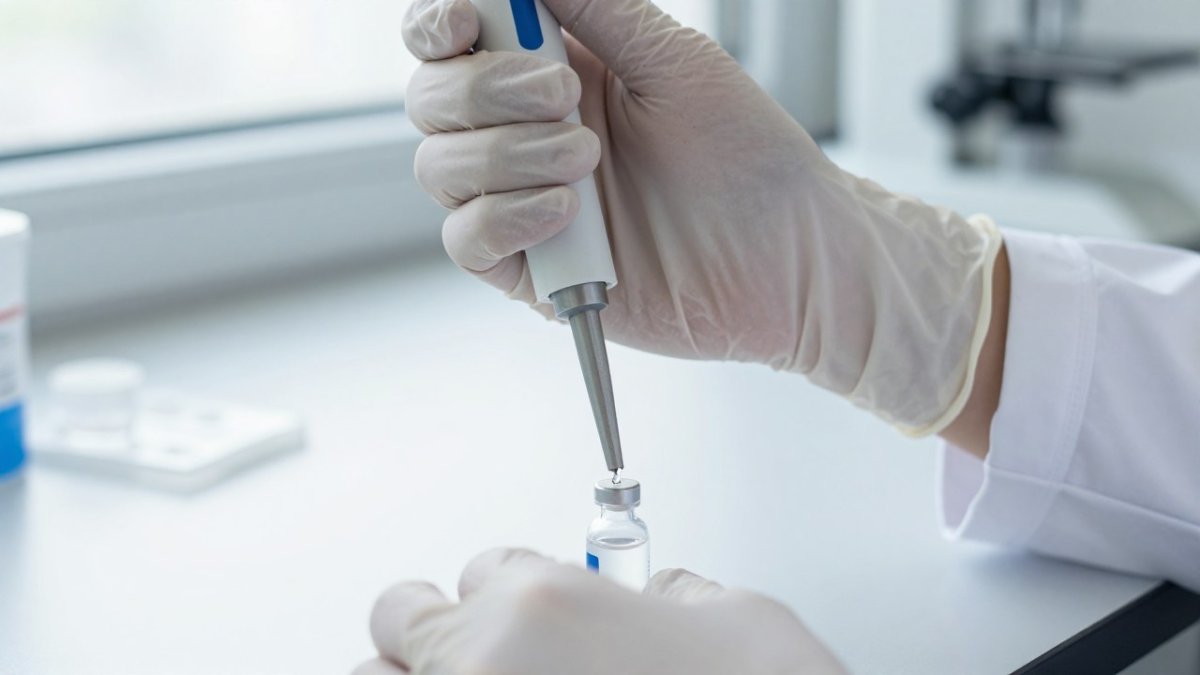
- Set aside a few micrograms to a small fraction of the vial as a test sample.
- Add a small volume of your first-choice solvent and mix gently. Avoid vigorous vortexing, which can damage some peptides.
- Look for a clear solution with no visible particles or cloudiness.
- If it does not dissolve, move to the next solvent in your decision tree.
Clear solubility at room temperature is the goal. If the peptide only dissolves with heat or heavy agitation, treat that as a warning sign about stability.
Step 3: Calculate Solvent Volume and Stock Concentration
Once you know the right solvent, calculate the volume needed for your target stock concentration. Many suppliers suggest a stock concentration around 1 to 2 mg/mL as a practical starting point. GenScript peptide solubility and stability guide But mass-per-volume is only half the calculation. For cell culture you also need the molar concentration and the final vehicle percentage in the well, because those two numbers determine whether your dose is reproducible and whether the solvent itself is confounding your assay.
Convert mass to molarity using the molecular weight
Peptide doses in cell culture are usually reported in molar units (nM or µM), not mg/mL, because molarity is what lets another lab reproduce your treatment.
Worked example, a 1 mg vial of a peptide with MW 1,500 g/mol:
- Peptide mass: 1 mg = 1,000 µg
- Moles of peptide: 1,000 µg ÷ 1,500 g/mol = 0.667 µmol (because 1 µg ÷ (g/mol) = nmol, so 1,000 µg ÷ 1,500 = 0.667 nmol × 1,000 = 667 nmol = 0.667 µmol)
- If you dissolve in 1 mL of solvent, the stock is 0.667 µmol/mL = 667 µM
If your target stock is 1 mM instead, rearrange: volume = moles ÷ concentration = 0.667 µmol ÷ 1,000 µmol/mL = 0.000667 mL, which is impractically small.
Calculate the final concentration and vehicle percentage in the well
The stock concentration is not the dose your cells see. The dose is set by the dilution into medium, and the same dilution factor applies to the solvent.
Worked dilution example:
- Stock: 667 µM in 100% DMSO
- You add 1 µL of stock to 1 mL of medium: dilution factor = 1,000 µL ÷ 1 µL = 1,000-fold
- Final peptide concentration: 667 µM ÷ 1,000 = 0.667 µM (667 nM)
Now run it the other way. If your cells tolerate no more than 0.1% DMSO, and your stock is in 100% DMSO, the maximum volume of stock you can add to 1 mL of medium is 1 µL.
Watch out: a stock made in 100% DMSO and added directly to serum-containing medium can precipitate at the interface before it mixes.
Keep a calculation record
Write down the MW, the mass weighed, the solvent volume, the stock concentration in both mg/mL and µM, the dilution factor, and the final vehicle percentage. If any one of those is missing, the experiment is not reproducible.
Step 4: Handle Sterility, Filtration and Solvent Limits in Culture
Cell culture demands sterile technique. Work in a biosafety cabinet, use sterile diluents, and keep caps closed when you can. But sterility is not a single step, it is a decision about where contamination can enter and what you are willing to lose to remove it.
Decide whether you need filtration at all
Filtration is not automatically required for every stock. Work through this order:
- Start sterile where possible. Use sterile water, sterile-filtered buffer, and USP-grade or cell-culture-grade DMSO. A peptide vial that was lyophilized and sealed under clean conditions is not sterile, but it is usually low-bioburden. If every liquid you add is sterile and you work in a biosafety cabinet with sterile pipette tips, many labs skip filtration for short-term stocks.
- Filter when the stock will be stored, shared, or used in sensitive cultures. Primary cells, serum-free cultures, and any stock kept for weeks are the cases where a 0.22 µm filtration step earns its place.
- Do not filter if the peptide is known to bind the membrane. Hydrophobic sequences and peptides with strong positive charge are the usual offenders.
Match the filter to the peptide
Filter material matters more than pore size for peptide recovery:
- PES (polyethersulfone): low protein binding, the usual first choice for aqueous peptide solutions.
- PVDF (polyvinylidene fluoride): also low binding, good for aqueous and some organic mixes; check compatibility with your solvent.
- Cellulose acetate: low binding, but less robust with high organic content.
Pore size is a separate choice. A 0.22 µm filter removes bacteria; a 0.45 µm filter is faster and less likely to clog but does not sterilize.
Recovery check: filter a small test volume, then compare peptide concentration before and after by UV absorbance at 280 nm (if the sequence contains tryptophan or tyrosine) or by the supplier's suggested method.
Watch out: filtering a DMSO stock through a nylon or cellulose membrane can dissolve or swell the membrane.
Set solvent limits before you treat cells
Solvent limits matter in culture, and they are cell-type specific. There is no universal safe percentage, so the only defensible approach is to test your vehicle on your cells.
- DMSO: many labs keep final DMSO at or below 0.1% (v/v) for routine work, and some sensitive lines require 0.05% or less. Run a vehicle dose-response (for example 0%, 0.05%, 0.1%, 0.2%, 0.5%) alongside your peptide treatment and pick the highest vehicle level that shows no effect on your readout.
- Acidic or basic solvents: acetic acid, ammonium bicarbonate, and similar solvents must be diluted enough that they do not shift medium pH. Check pH after addition in a pilot well before committing the plate.
- Ethanol and methanol: usable for some hydrophobic peptides but volatile and cytotoxic at higher percentages; treat them like DMSO and establish a vehicle control.
Always include a vehicle control containing the same solvent amount without peptide, matched to the final treatment concentration. Without it, you cannot tell whether an effect came from the peptide or the solvent.
Keep sterility and solvent records together
Record whether the stock was filtered, the filter material and pore size, the recovery check result, the final vehicle percentage in each well, and the vehicle control level. These details are what let you, or a reviewer, distinguish a real peptide effect from a filtration loss or a solvent artifact.
Troubleshooting: What to Do When a Peptide Is Not Dissolving
If a peptide will not dissolve, work through this checklist:
- Confirm you used the correct first solvent for the peptide's charge.
- Try a small increase in acid or base, or switch to DMSO for hydrophobic peptides.
- Allow more time with gentle mixing rather than heavy vortexing.
Several supplier references suggest trying water first and then a dilute acetic acid solution, which gives a clear, practical order of steps. MedChemExpress peptide solubility and storage guidelines
Watch out: adding too much organic solvent to a stock can precipitate the peptide when it hits aqueous medium. Dilute slowly and mix as you go.
Storing Aliquots to Keep Your Stock Stable Between Experiments
Do not repeatedly freeze and thaw a full stock. Divide it into small single-use aliquots and store them frozen, protected from light.
Good storage habits include:
- Label each aliquot with peptide name, lot number, concentration, solvent and date.
- Use low-protein-binding tubes where possible.
- Avoid more than one or two freeze-thaw cycles per aliquot.
Your stock stability depends on storage as much as on preparation.
Building Your Stock Preparation Record and Next Steps With Your Peptides
Keep a written record for every stock you prepare. A simple log should include:
| Field | What to Record |
|---|---|
| Peptide name and sequence | From the COA |
| Lot number | Matches the vial and COA |
| Molecular weight | From the COA |
| Solvent and volume | Including any acid, base or DMSO |
| Stock concentration | Calculated value |
| Storage location and date | Freezer, aliquot count |
Matching the lot number to your COA lets you trace results back to a verified batch. Quality Peptide USA provides a Certificate of Analysis with each batch, so you can check purity and identity before you start. For more detail, see our guide on documenting peptide lot numbers in research records.
Ready to start your next experiment? Browse our research-grade peptides at Quality Peptide USA.
Frequently Asked Questions
How do you prepare a peptide stock solution for cell culture?
Start by checking the peptide sequence and whether it is charged or hydrophobic. Test solubility on a small portion first, then dissolve the peptide in sterile distilled water if it allows, or in a minimal volume of a stronger solvent such as DMSO or dilute acetic acid if it does not. Add solvent slowly, mix gently, and confirm the peptide is fully dissolved before making a higher-concentration stock. Filter-sterilize if the solvent and filter are compatible, aliquot the stock, and store it frozen and protected from light. Final solvent concentration in the culture medium should be kept low and matched by a vehicle control.
What solvent should you use to dissolve a peptide for a cell-based assay?
Sterile distilled water is the usual first choice because it is compatible with most cell-based work. Peptides that are poorly soluble in water may require dilute acetic acid for basic peptides or a small amount of dimethyl sulfoxide (DMSO) for hydrophobic peptides. Because DMSO can affect cell viability at higher concentrations, keep the final concentration in culture low and include a vehicle control with the same solvent amount. The right choice depends on the sequence, so test a small sample before committing the full vial.
How do you calculate the concentration of a peptide stock solution?
Divide the mass of peptide by the volume of solvent added. For example, dissolving 1 mg of peptide in 1 mL of solvent gives a 1 mg/mL stock. Many suppliers suggest a stock of roughly 1 to 2 mg/mL as a starting point. To reach a target molar concentration, use the peptide's molecular weight from the certificate of analysis. Then calculate the volume needed for your final working concentration in culture by dividing the stock concentration by the desired concentration and keeping the solvent fraction in the medium low.
How should peptide stock solutions be stored?
Aliquot the stock into single-use volumes to avoid repeated freeze-thaw cycles, then store frozen at the temperature recommended by the supplier, often -20 C or colder for longer periods. Keep vials protected from light and sealed to limit moisture. Label each aliquot with the peptide name, concentration, solvent, and preparation date. Peptide stability varies by sequence, so follow the storage guidance on your certificate of analysis or the manufacturer's technical resource.
