


October 30, 2026 · Editorial Team
How Do You Document Peptide Lot Numbers in Research Records?
Document peptide lot numbers in research records with a field-by-field template, COA matching steps, and a sample tracking log built to hold up to audit.

Last Updated: October 30, 2026
Quick Summary
Document peptide lot numbers by recording the manufacturer's batch code from each vial label and matching it character for character to the certificate of analysis before the vial enters storage. Log that lot number in a peptide inventory log template, one row per lot, and link every aliquot's internal sample ID back to its parent lot in your sample tracking log.
- Confirm the vial label lot number matches the COA character for character before use.
- Keep manufacturer lot numbers and internal sample IDs as separate fields, never one replacing the other.
- Record one row per lot in a flat inventory template with fixed columns.
- Never erase a wrong entry; strike it through, add initials, date, and reason.
- Retain COAs for as long as you keep the data the batch produced.
Table of Contents
- What a Lot Number Records and Why It Decides Reproducibility
- What You'll Need Before the First Vial Arrives
- Step 1: Match the Vial Label to the Certificate of Analysis
- Step 2: Build a Peptide Inventory Log Template That Covers Every Field
- Step 3: Run a Peptide Sample Tracking Log From Receipt to Aliquots
- Step 4: Handle Discrepancies, Corrections, and Audit Trails
- Step 5: Set Up Electronic Recordkeeping, File Naming, and COA Retention
- Ordering Peptide Batches With Documentation You Can Verify
- Frequently Asked Questions
What a Lot Number Records and Why It Decides Reproducibility
Peptide lot numbers are the manufacturer's unique codes for one production batch, and they are the thread that ties every vial in your lab back to a single certificate of analysis. Lose that thread and you lose reproducibility. Two vials from the same catalog number, ordered months apart, can behave differently if they came from different batches. If your research records don't capture which batch each sample came from, you can't explain a failed replicate or defend a result.
Lot traceability is the practice of linking every sample, aliquot, and experiment to the batch documentation that produced it. It answers three questions fast: where did this material come from, what testing backed it, and what else did we run with it?
Manufacturer lot numbers versus your internal sample IDs
These are two different things, and confusing them is the most common mistake we see.
- Manufacturer lot number: assigned by the supplier. Identifies the production batch. Never changes.
- Internal sample ID: assigned by your lab. Identifies a specific vial or aliquot on your shelf.
You need both. The lot number proves origin. The sample ID proves what you actually handled. A good record shows the lot number feeding into the sample ID, not one replacing the other.
What You'll Need Before the First Vial Arrives
Set up your recordkeeping before the shipment lands. Building the system after the fact means reconstructing data from memory, and that's where errors creep in.
Here's the short list:
- A peptide inventory log template with fixed columns (more on this in Step 2)
- A peptide sample tracking log for aliquots
- A naming convention for files and sample IDs
- A folder structure for certificates of analysis
- A designated person who owns record updates
The NIH guidelines on rigor and reproducibility emphasize that clear documentation of reagents and materials is central to reproducible research. Batch-level records are part of that standard, not an optional extra.
Step 1: Match the Vial Label to the Certificate of Analysis
Matching means confirming that the lot number printed on the vial label is identical to the lot number on the certificate of analysis (COA) for that batch. No match, no use. This is the single most important check in the whole workflow.
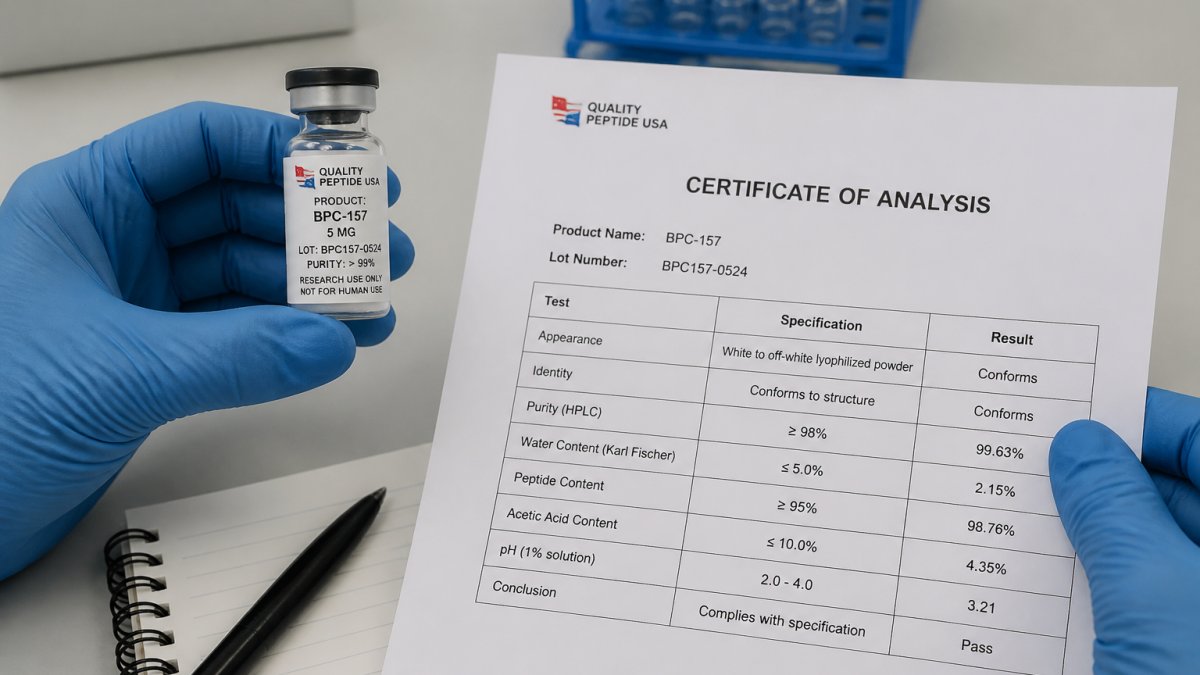
Run the check in this order:
- Read the lot number on the vial. Write it down exactly.
- Pull the COA for that catalog number.
- Confirm the lot number matches character for character.
- Confirm the product name and catalog reference match.
- Confirm the report date is current for that batch.
- Flag any mismatch before the vial enters storage.
A vial with no matching COA is an unverified sample. Treat it that way.
How to read a peptide COA field by field
A COA is only useful if you know what each field proves.
- Product name and catalog reference: confirms you have the right compound.
- Lot or batch number: the batch match check.
- CAS number: the unique chemical identifier for the compound (CAS REGISTRY).
- Report date: tells you which batch generation the testing covers.
- Identity method: usually mass spectrometry, which confirms the compound is what the label says.
- Purity: typically from HPLC, expressed as a percentage of the main peak.
- HPLC results: the chromatogram and peak data behind the purity figure.
For a deeper walkthrough of reading purity and identity data, see our guide on how to verify peptide purity. You can review what testing backs each batch on our lab testing page.
Step 2: Build a Peptide Inventory Log Template That Covers Every Field
Your peptide inventory log template should capture every field you'd ever need to answer a question about a batch. Build it once, use it for every order.
| Field | What to Record | Example Format |
|---|---|---|
| Product name | Full name as labeled | Peptide X |
| Catalog reference | Supplier catalog number | CAT-0000 |
| Lot number | Manufacturer batch code | LOT-000000 |
| CAS number | Chemical identifier | 000-00-0 |
| Report date | COA date | YYYY-MM-DD |
| Identity method | Test used to confirm identity | Mass spectrometry |
| Purity | HPLC purity figure | Recorded as reported |
| Received date | Date vial arrived | YYYY-MM-DD |
| Storage location | Freezer, shelf, box | Freezer 2, Box A |
| Internal sample ID | Your assigned ID | LAB-0001 |
Keep the template flat. One row per lot. Don't merge cells or add free-text notes in place of structured fields. If you want to know which purity and COA data points are worth logging for each lot, our HPLC testing guide explains what the numbers mean.
Step 3: Run a Peptide Sample Tracking Log From Receipt to Aliquots
A peptide sample tracking log follows each vial from arrival through aliquoting and use. The inventory log tracks lots. The sample tracking log tracks physical samples.
Record these events:
- Receipt date and condition on arrival
- Initial storage location
- Aliquot date and number of aliquots created
- Sample ID assigned to each aliquot
- Storage location of each aliquot
- Date each aliquot is opened or used
- Experiment or protocol ID each aliquot supports
Link every aliquot back to its parent lot number in your peptide lot numbers records. That single link is what lets you trace a result from an experiment all the way back to the batch documentation. For handling and storage protocols that protect stability from receipt onward, follow our guidance on how to store peptides for long-term stability.
Step 4: Handle Discrepancies, Corrections, and Audit Trails
Discrepancies happen. What matters is how you record them.
Watch out: Never erase or overwrite a wrong entry. A corrected record that hides the original error is worse than the error itself, because it destroys the audit trail.
Use this correction method:
- Strike through the error with a single line so it stays readable.
- Write the correct value beside it.
- Add your initials and the date of the correction.
- Note the reason for the change in a dedicated field.
Common discrepancies to log:
- Lot number on the vial doesn't match the COA
- Purity figure on the COA doesn't match what your own testing shows
- Vial arrives damaged or unlabeled
- Aliquot count doesn't match what you recorded
For regulated or audited research, keep a separate discrepancy log with dates, actions taken, and who resolved each item. This is the paperwork an auditor will ask for first.
Step 5: Set Up Electronic Recordkeeping, File Naming, and COA Retention
Electronic records beat paper for one reason: searchability. When a reviewer asks which lots supported a study, you want an answer in seconds, not an afternoon in a filing cabinet.
Set a file naming convention and stick to it:
[catalog-reference]_[lot-number]_[report-date]_COA.pdf
Retention rules to follow:
- Keep COAs for as long as you keep the data the batch produced.
- Back up records in a second location.
- Restrict editing permissions so records can't be silently changed.
- Log who accessed or modified each record.
The FDA guidance on electronic records and signatures sets out expectations for record integrity when electronic systems are used in regulated work. Even outside a regulated setting, the same principles keep your records trustworthy.
Ordering Peptide Batches With Documentation You Can Verify
Good documentation starts with the supplier. If the COA is incomplete or the lot number doesn't reconcile, no amount of careful recordkeeping fixes it.
Quality Peptide USA provides a transparent third-party Certificate of Analysis for every batch. Peptides are synthesized, tested, and packaged within the United States. You can contact our research support team with documentation questions before you order.
Frequently Asked Questions
Where can I find the lot number on a peptide vial?
The lot number is usually printed on the vial label near the product name, catalog reference, and fill size. On small vials it may sit on the side of the label or on a wrap-around section, so rotate the vial under good light before recording anything. If the label is smudged or the number is unreadable, do not guess: check the packing slip and the certificate of analysis for the batch, and contact the supplier to confirm which peptide lot numbers shipped. Record the number exactly as printed, including any prefixes or suffixes.
What information should I record for each peptide lot?
At minimum, log the product name, catalog reference, lot or batch number, CAS number if listed, fill size, receipt date, storage location, and the COA report date. Add the identity method and purity result from the COA so the record stands alone without the paperwork. If you aliquot, assign each vial a sample ID that points back to the lot. A peptide inventory log template with these fields means a reviewer can trace any result to a specific batch without hunting through emails or folders.
What should I do if the vial label and COA show different lot numbers?
Stop and quarantine the vial before use. Photograph the label and the COA side by side, note the mismatch in your research log with the date and your initials, and contact the supplier for written confirmation of which batch the vial belongs to. Do not overwrite the original entry; add a correction line that references the discrepancy. A documented mismatch is a finding you can defend. An undocumented one becomes an unexplained gap in your records if the batch is ever questioned.
Should I record the lot number every time I use a peptide?
Yes, at the point of use rather than only at receipt. Each experiment entry should carry the sample ID and the parent lot number, so a result can be tied to one batch even after aliquoting. This matters when a study runs for months across multiple shipments. If a later review questions a data point, the peptide sample tracking log shows exactly which vial was used, when it was opened, and how it was stored, which is the difference between a reproducible study and an untraceable one.
Building a record system that holds up takes discipline, and it starts with a supplier whose paperwork you can trust. Quality Peptide USA gives you a verifiable COA for every batch, domestic synthesis and packaging, and same-day shipping on orders placed before 2PM EST. Get started with Quality Peptide USA and build research records that stand up to scrutiny.
