


October 26, 2026 · Editorial Team
How to Reconstitute Lyophilized Peptides for Laboratory Research
Reconstitute lyophilized peptides correctly with our step-by-step guide to sterile technique, diluent selection, and storage. Learn best practices now.
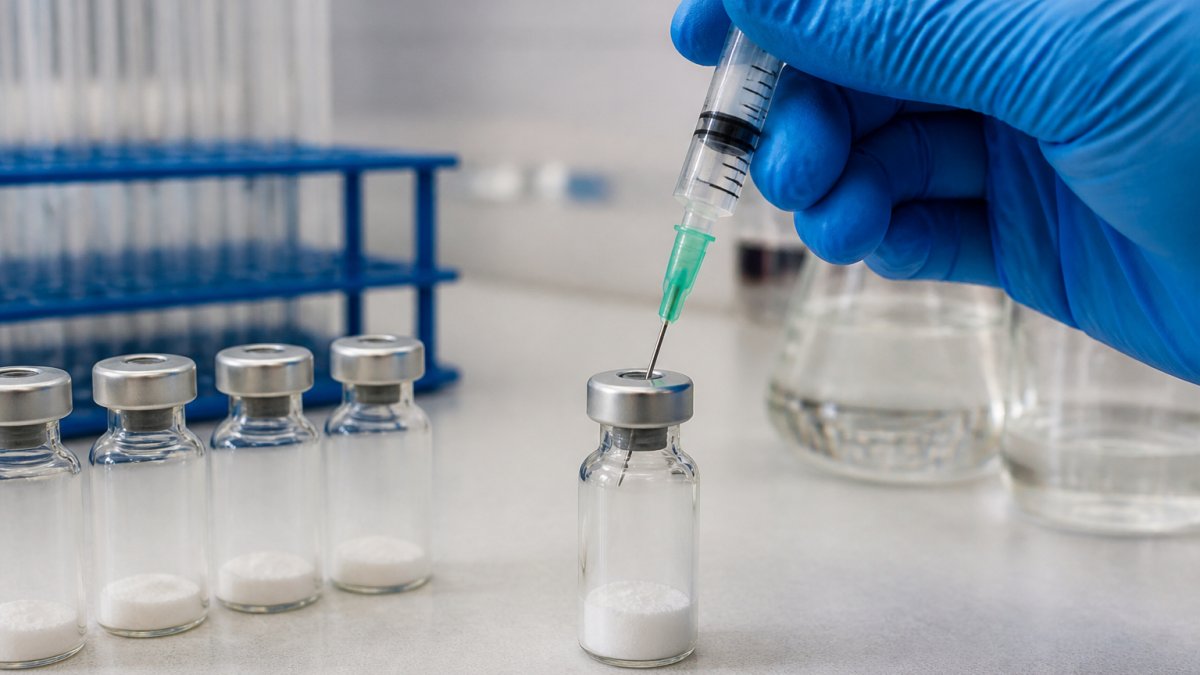
Last Updated: October 26, 2026
Quick Summary
To reconstitute lyophilized peptides, dissolve the freeze-dried powder in a sterile diluent by slowly injecting the solvent into the vial at the wall, then gently swirl for 5 minutes until the powder dissolves completely. Always consult the manufacturer's technical documentation for the correct solvent, as peptide solubility depends on amino acid composition.
- Bacteriostatic water contains 0.9% benzyl alcohol and inhibits bacterial growth, while sterile water is pure H₂O with no additives.
- Calculate concentration using the formula: Concentration (mg/mL) = Peptide mass in mg divided by final volume in mL, adjusting for purity percentage.
- Reconstituted peptides remain stable for 2-4 weeks at 2-8°C or can be frozen at -20°C or below in aliquots to avoid repeated thaw-freeze cycles.
- Inject diluent slowly at the vial wall, not directly onto the powder, to reduce foaming and allow gradual hydration.
- Document the peptide lot number, reconstitution date, diluent used, final concentration, and any deviations from the manufacturer's protocol.
Table of Contents
- What Lyophilized Peptides Are and Why Reconstitution Matters
- Supplies and Equipment You Need Before Starting
- Peptide Solubility and Solvent Selection
- Calculating Peptide Concentration Using a Peptide Concentration Calculator
- Step-by-Step Reconstitution Procedure with Aseptic Technique
- How to Store Reconstituted Peptides
- Peptide Reconstitution Troubleshooting
- Research-Use Boundaries and Documentation
- Frequently Asked Questions
What Lyophilized Peptides Are and Why Reconstitution Matters
Lyophilized peptides are freeze-dried protein fragments stored in powder form to preserve their stability and potency over time.
Reconstitution matters because it activates the peptide for your experiments. The freeze-drying process removes water, which slows molecular breakdown and extends shelf life (Practical advice in the development of a lyophilized protein drug product).
Most researchers underestimate how much the reconstitution step itself affects their results. A careless approach introduces contamination, degrades the peptide through improper handling, or produces an incorrect concentration, all of which tank downstream experiments.
At Quality Peptide USA, we provide research-grade peptides. Our peptides are independently verified and HPLC-tested.
Supplies and Equipment You Need Before Starting
Before you open a vial, gather everything on this list. Missing even one item forces you to improvise, and improvisation in the lab is how contamination sneaks in.
Essential supplies:
- Sterile syringes (1 mL, 3 mL, or 10 mL depending on your volume needs)
- Sterile needles (25-gauge or 27-gauge for small volumes)
- Alcohol prep pads (70% isopropyl alcohol minimum)
- Sterile diluent (bacteriostatic water or sterile water, we cover the difference below)
- Sterile gloves (nitrile or latex)
- Safety glasses or face shield
- Biosafety cabinet or laminar flow hood (for aseptic work)
Optional but recommended:
- Sterile gauze pads for cleaning the rubber stopper
- Sterile pipette tips if you're using automated pipetting
- Microcentrifuge tubes for aliquoting after reconstitution
- Labels and a permanent marker for dating and lot tracking
The biosafety cabinet is not optional if your protocol requires sterility assurance. If your research does not mandate sterile technique, you can work at a clean bench, but aseptic precautions still apply. Contamination ruins months of work downstream.
Before you start, verify the peptide purity by reviewing Lab testing you can verify.
Peptide Solubility and Solvent Selection
Peptide solubility depends on the amino acid composition of your specific peptide. Some peptides dissolve readily in water. Others require organic solvents or pH-adjusted solutions to go into solution.
Do not assume all peptides behave the same way. A peptide rich in hydrophobic amino acids may resist dissolving in plain water. One with charged residues may need a buffered solution at a specific pH.
Always consult the peptide's technical documentation before selecting a solvent. If the manufacturer recommends a specific diluent, use it.
Bacteriostatic Water Versus Sterile Water
This choice matters more than most researchers realize. Bacteriostatic water contains 0.9% benzyl alcohol, which inhibits bacterial growth but can interfere with some assays. Sterile water has no additives, it is pure H₂O that has been sterilized by filtration or autoclaving.
Use bacteriostatic water if:
- Your peptide will be stored as a working solution for more than a few days
- Your protocol does not involve bacterial culture or live-cell work where benzyl alcohol could confound results
- You want a built-in antimicrobial buffer
Use sterile water if:
- Your assay is sensitive to organic additives
- You are working with live cells or organisms where benzyl alcohol is contraindicated
- Your protocol explicitly requires it
Both are sterile. The difference is chemical composition, not sterility. Check your experimental protocol and the peptide manufacturer's recommendation, they usually specify which one to use.
Calculating Peptide Concentration Using a Peptide Concentration Calculator
Getting the math right prevents wasted reagent and failed experiments.
The formula: Concentration (mg/mL) = (Peptide mass in mg) ÷ (Final volume in mL)
Example: You have a 10 mg vial and you want to reconstitute it to 1 mg/mL. You need 10 mL of diluent.
Before you calculate, confirm three things:
- The actual mass of peptide in the vial (check the label, not the box)
- The purity percentage from the Certificate of Analysis
- The final volume you need for your experiment
Many labs use a peptide concentration calculator tool to avoid arithmetic errors.
Write down your calculation and keep it with your lab notebook. You will need it later to document your work and troubleshoot if results are unexpected.
Step-by-Step Reconstitution Procedure with Aseptic Technique
Vial Inspection and Preparation
Before you add anything to the vial, inspect it for damage. Look for cracks, cloudiness inside the vial, or visible moisture. A compromised vial means the peptide may have been exposed to moisture or air during storage, contamination risk goes up.
If the vial looks intact, proceed with preparation:
- Wipe the rubber stopper with an alcohol prep pad using firm, circular motions. Let it air dry for 30 seconds. Do not touch the stopper after it dries.
- Prepare your workspace. If using a biosafety cabinet, turn it on and let it run for 5 minutes before starting. Wipe down the work surface with 70% alcohol.
- Put on sterile gloves and safety glasses. Never touch your face or other surfaces once gloved.
- Draw up your diluent into a sterile syringe using aseptic technique. Keep the needle sterile by not letting it touch non-sterile surfaces.
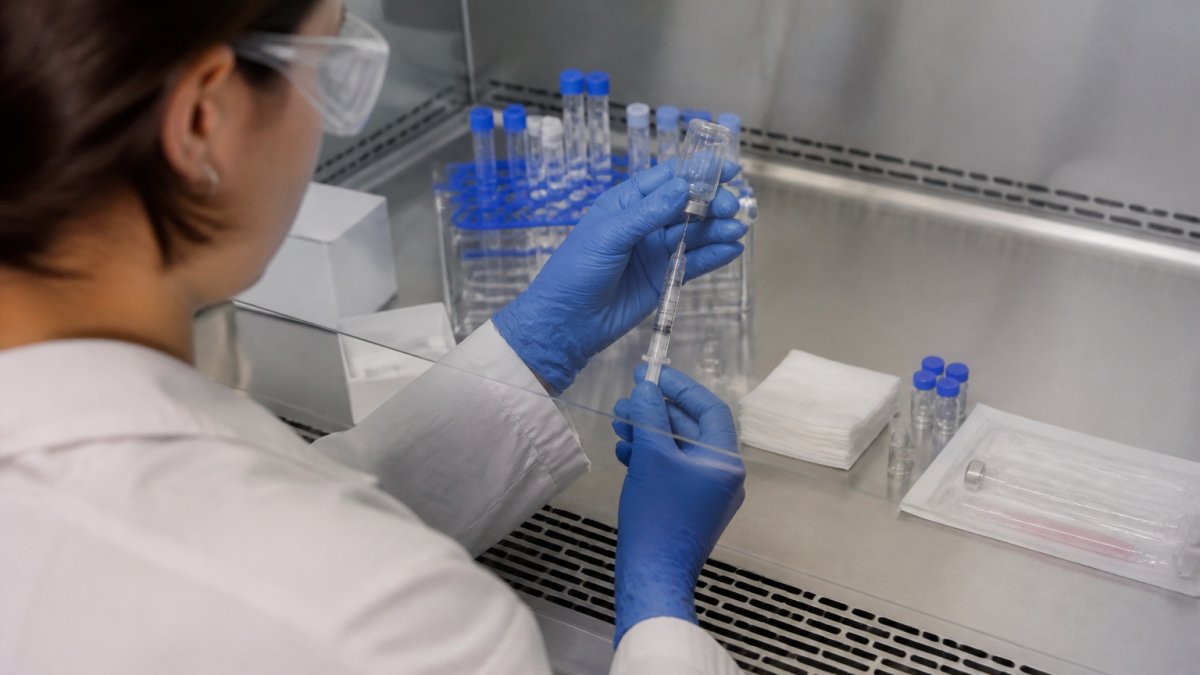
Sterile Injection and Gentle Mixing
This is where precision and patience pay off. Rushing this step introduces air bubbles, foaming, or aggregation.
- Insert the needle through the rubber stopper at a slight angle. Push slowly and steadily. Do not stab or force it.
- Inject the diluent slowly into the vial. Aim the stream at the vial wall, not directly onto the powder. This reduces foaming and allows the powder to wet gradually.
- Withdraw the needle and syringe. Do not leave the needle in the vial, it introduces air.
- Let the vial sit for 2-3 minutes. The peptide needs time to hydrate. Visible powder should begin to dissolve.
- Gently swirl the vial between your palms. Do not shake it vigorously. Shaking introduces air and can denature the peptide.
- Repeat gentle swirling every minute for 5 minutes total. The peptide should dissolve completely. If you see particulates after 5 minutes, the solvent may be wrong, do not force it.
If the solution remains cloudy or contains visible particulates after 10 minutes, the peptide may not be fully soluble in that diluent. Stop and consult the manufacturer's protocol. Proceeding with an insoluble peptide wastes your material and produces unreliable results.
Once you successfully reconstitute lyophilized peptides, the solution should be clear. Write the reconstitution date on the vial label with a permanent marker.
Follow these steps in order, paying careful attention to timing and technique to avoid contamination and peptide degradation.
| Step | Action | Timing |
|---|---|---|
| Vial inspection | Check for cracks, cloudiness, or visible moisture | Before starting |
| Stopper cleaning | Wipe rubber stopper with alcohol pad using circular motions | 30 seconds air dry after |
| Workspace prep | Turn on biosafety cabinet and wipe surface with 70% alcohol | 5 minutes cabinet run time |
| Diluent injection | Insert needle at angle and inject slowly at vial wall | Slow, steady motion |
| Initial hydration | Let vial sit undisturbed after injection | 2-3 minutes |
| Gentle mixing | Swirl vial between palms, repeat every minute | 5 minutes total |
| Dissolution check | Observe for complete dissolution and clarity | After 5-10 minutes |
| Labeling | Write reconstitution date on vial with permanent marker | Upon successful dissolution |
How to Store Reconstituted Peptides
Reconstituted peptides are less stable than lyophilized powder. Once in solution, they begin to degrade. Storage conditions determine how long your solution remains usable.
Short-term storage (days to weeks):
- Store at 2-8°C in a standard laboratory refrigerator
- Keep the vial sealed with the original rubber stopper
- Reconstituted peptides typically remain stable for 2-4 weeks under these conditions
Long-term storage (months):
- Freeze at -20°C or below
- Use sterile, low-protein-binding microcentrifuge tubes
- Divide the reconstituted solution into aliquots before freezing to avoid repeated thaw-freeze cycles
- Label each aliquot with the peptide name, concentration, reconstitution date, and lot number
Freeze-thaw cycles degrade peptides (Impact of Freeze-thaw Cycles and Storage Time on Plasma Samples Used in Mass Spectrometry...). If you freeze a solution, plan to use it in one or two thaws maximum. Aliquoting before freezing prevents waste.
For detailed storage protocols specific to your peptide, learn how to store peptides for long-term stability.
Peptide Reconstitution Troubleshooting
Problem: The powder won't dissolve. The peptide may not be soluble in your chosen diluent. Confirm the manufacturer's recommended solvent from the Certificate of Analysis.
Problem: The solution is cloudy or contains visible particulates. Cloudiness often means incomplete dissolution, aggregation, or contamination. If you followed the correct protocol and used the right solvent, the batch may have a quality issue. Verify peptide purity before reconstituting.
Problem: The solution foams excessively. Vigorous mixing or shaking introduces air. Foam traps peptide molecules and can cause aggregation. Discard the solution and start over.
Problem: The concentration seems off when I test it. Verify your calculation.
Problem: The solution degrades quickly after reconstitution. Reconstituted peptides degrade faster at room temperature than in the refrigerator. Store at 2-8°C immediately after reconstitution.
Research-Use Boundaries and Documentation
Your institution's Institutional Review Board or compliance office has specific guidance on what constitutes approved research use. Familiarize yourself with those boundaries before beginning work.
Document everything:
- Peptide lot number and Certificate of Analysis
- Reconstitution date and diluent used
- Final concentration and volume
- Storage location and conditions
- Any deviations from the manufacturer's protocol
- Test results if you verified purity or sterility in-house
Documentation protects your research integrity and provides a record if questions arise later about batch quality or experimental validity.
Before sourcing peptides for a new project, buy cGMP compliant peptides.
Reconstituting lyophilized peptides correctly is the foundation of reliable research. Small details, aseptic technique, solvent choice, gentle handling, compound into the difference between clean results and contaminated batches. Quality Peptide USA provides research-grade peptides with independent HPLC verification.
Frequently Asked Questions
What is the difference between bacteriostatic water and sterile water for reconstituting peptides?
Sterile water is pure water that has been sterilized and contains no additives. Bacteriostatic water contains 0.9% benzyl alcohol, which inhibits bacterial growth and is preferred for multi-dose vials that will be used over time. For single-use or short-term storage, sterile water is appropriate. For peptides stored at room temperature or used across multiple days, bacteriostatic water reduces contamination risk. Always verify your peptide's Certificate of Analysis and manufacturer documentation for the recommended diluent.
How do I calculate the correct reconstitution volume for my peptide?
Use this formula: Reconstitution Volume (mL) = (Peptide Weight in mg × 1000) / Desired Final Concentration (µg/mL). For example, to create a 100 µg/mL solution from 10 mg of freeze-dried peptide, calculate (10 × 1000) / 100 = 100 mL of diluent. A peptide concentration calculator tool helps verify your math. Always double-check your calculations and refer to the manufacturer's recommended concentration range on the vial label or Certificate of Analysis.
What should I do if my lyophilized peptide does not dissolve completely?
Visible particulates or incomplete solubility can indicate peptide degradation, incorrect diluent selection, or contamination. First, verify you are using the correct diluent recommended by the manufacturer. Allow 15-30 minutes at room temperature with gentle swirling (never shake vigorously, as this can damage peptide structure). If solubility persists, the peptide may have lost stability due to improper storage or moisture exposure. Do not force dissolution by heating. Contact the supplier with your lot number and Certificate of Analysis for guidance before using the preparation in experiments.
How long can I store a reconstituted peptide solution?
Storage stability depends on the specific peptide, diluent, and storage conditions. Most reconstituted peptides remain stable for 2-4 weeks at 4°C (refrigerator) when prepared under sterile conditions with bacteriostatic water. Room-temperature storage significantly shortens shelf life. Always label your vial with the preparation date, lot number, concentration, and diluent used. Refer to your peptide's stability data sheet or Certificate of Analysis for the manufacturer's validated storage timeline. If visible particulates, discoloration, or cloudiness develop, discard the solution.
