

November 8, 2026 · Editorial Team
7 Phoenix Peptide Alternatives Researchers Should Evaluate
Looking for a research peptide supplier alternative to Phoenix Peptide? Compare sourcing, COA documentation, HPLC testing and shipping before you order.

Last Updated: November 7, 2026
Quick Summary
The best research peptide supplier for a Phoenix Peptide alternative provides verifiable purity, complete documentation, and dependable delivery. Evaluate each vendor against the same criteria, including the testing methods used, whether a batch-specific certificate of analysis is supplied before purchase, and where the product is synthesized and shipped.
- Request a batch-specific certificate of analysis and confirm its lot number matches your vial label and invoice.
- Check that HPLC purity figures match the integrated peak area on the chromatogram.
- Confirm peptide identity with mass spectrometry against the expected molecular weight.
- Ask for the same standardized quote from each supplier, including shipping and cold-chain fees.
- Consider independent re-testing of a retained sample for high-stakes experiments.
Table of Contents
- Why Researchers Are Looking for Phoenix Peptide Alternatives
- How to Build a Research Peptide Supplier Comparison Framework
- How to Verify Research Peptide Purity Before You Order
- What Research Peptide Supplier Testing Documentation Should Include
- Comparing Phoenix Peptide Alternatives Side by Side
- Research Peptide Shipping and Packaging Standards to Check
- Requesting a Quote and Documentation From Your Next Supplier
- Frequently Asked Questions
Researchers who depend on peptides know that a single weak batch can derail months of work. That is why many principal investigators and lab managers are now looking for a Phoenix Peptide alternative, and why Quality Peptide USA has put together this guide to help you evaluate options with a clear, repeatable method. (Source: why HPLC testing matters)
The core question is simple: which research peptide supplier gives you verifiable purity, complete documentation, and dependable delivery? Answering it takes more than comparing catalog size or list prices. You need to check how each vendor tests its products, what its certificates of analysis actually contain, and where its synthesis and shipping happen.
Why Researchers Are Looking for Phoenix Peptide Alternatives
Many labs start the search after a disruption rather than out of general curiosity. A supplier may stop taking orders, a product may become hard to restock, or a lab may simply find that documentation no longer meets its internal quality requirements.
A common mistake is treating a replacement purchase as a routine reorder. Teams that switch suppliers without a checklist often discover mismatched purity specifications or missing analytical data only after an experiment has started. Building a structured evaluation before the next order avoids that problem.
How to Build a Research Peptide Supplier Comparison Framework
A useful comparison framework scores each supplier against the same criteria, so differences in marketing language do not decide the outcome.
Weight the categories by what your study needs. An in vivo study with sensitive endpoints may justify extra weight on endotoxin data, while a high-throughput in vitro screen may care more about lot-to-lot consistency.
Key criteria to record for each supplier:
- The analytical methods named (for example HPLC and mass spectrometry)
- Whether a batch-specific certificate of analysis is provided before purchase
- Stated purity specifications and how they are measured
- Country of synthesis, packaging, and shipping
- Turnaround time and what happens if a shipment is damaged or mislabeled
Keep the scoring sheet with your procurement records. It also helps when a principal investigator or institutional committee asks why a supplier was chosen.
How to Verify Research Peptide Purity Before You Order
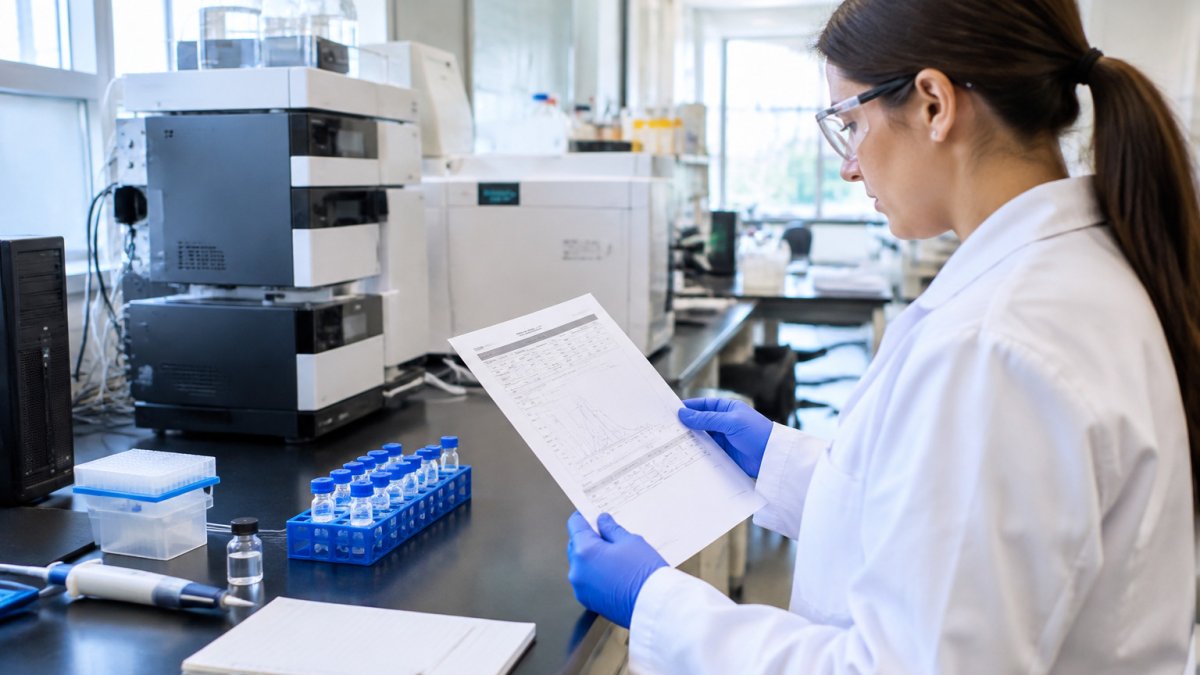
Purity claims are only as useful as the data behind them. Learn why HPLC testing matters and how to evaluate a certificate of analysis. A figure such as "99% purity" means little unless you know the method, the batch it applies to, and the conditions of the test. For a step-by-step walkthrough of HPLC, mass spectrometry, and COA review, see our lab guide.
Work through these steps in order:
- Request a batch-specific COA. A generic sheet that does not match the lot number is a warning sign.
- Check the HPLC chromatogram. HPLC separates the main peptide from impurities. Confirm that the purity percentage matches the integrated peak area shown on the chromatogram.
- Confirm identity with mass spectrometry. Mass spectrometry should match the expected molecular weight of the sequence.
- Review sterility and endotoxin data if your study is in vivo or involves cell cultures sensitive to contamination.
- Consider independent re-testing for high-stakes experiments. Some labs send a retained sample to an outside facility to confirm results.
If a supplier cannot explain its methods in plain terms, or refuses to share chromatograms, treat that as a reason to look elsewhere.
What Research Peptide Supplier Testing Documentation Should Include
Documentation is where many vendor comparisons break down. A supplier can advertise high purity, but your lab needs the paperwork to show that purity for the specific vial you receive. Strong documentation makes audits, publications, and troubleshooting much easier. The problem is that most supplier pages stop at listing the documents they provide.
A complete documentation package generally includes the lot number, the sequence and molecular weight, HPLC purity with the chromatogram, mass spectrometry identity data, the test date, and the name of the laboratory that performed the analysis. You can review the specific tests run on every batch on our Lab Testing You Can Verify page.
A Four-Point Independent Verification Method for COAs
Rather than trusting a COA because it looks official, run every certificate through the same four checks. This is the step most comparison articles skip, and it is the one that separates usable documentation from decoration.
- Batch matching. Confirm that the lot number on the COA matches the lot number printed on the vial label, the packing slip, and the invoice. A COA that references a different lot, or a range of lots, does not document your material. Ask for the certificate tied to the specific lot you will receive, not a representative sample from a prior run.
- Analytical method specificity. A purity figure should name the method and the conditions. For HPLC, look for the column type, mobile phase, gradient, detection wavelength, and integration method. For mass spectrometry, look for the ionization mode and the observed versus expected mass. A COA that says only "HPLC 99%" without a chromatogram or method detail cannot be reproduced or challenged.
- Dates and stability logic. Check the test date against the synthesis date and the shipping date. A COA dated months before the batch was synthesized, or a certificate reused across multiple lots, is a warning sign. Also check whether the certificate states a retest or expiration date and whether storage conditions on the label match the conditions the analytical laboratory used.
- Laboratory independence. Identify the laboratory that performed the analysis and confirm it is not the same entity as the seller. Independent laboratories publish their own methods and accreditation status. If the COA carries no laboratory name, or the name resolves to the supplier's own facility, treat the data as internal quality control rather than independent verification.
Watch out: a COA can be internally consistent and still describe a different lot than the one in your hand, so always reconcile the lot number across the vial, the packing slip, and the certificate before you open the material.
What to Do When Documentation Is Incomplete
If a supplier cannot produce a batch-specific certificate before purchase, ask what it can provide and in what timeframe. Some suppliers release COAs only after an order ships, which leaves your lab unable to evaluate the material in advance.
For high-stakes work, retain a sample from each lot and send it to an independent laboratory for confirmatory testing. This does not replace the supplier's COA, but it gives your lab its own record of identity and purity.
Comparing Phoenix Peptide Alternatives Side by Side
The table below applies the framework above to the types of supplier researchers most often evaluate. It does not rank vendors on price, because pricing depends on quantity, delivery timing, and custom requirements, and current prices should be requested directly from each supplier. Current pricing is available on Quality Peptide USA's website or through a quote request.
| Criterion | What to Check | Why It Matters |
|---|---|---|
| Testing method | HPLC and mass spectrometry named | Confirms purity and identity |
| Documentation | Batch-specific COA before purchase | Supports audit and publication needs |
| Manufacturing | Synthesis and packaging location | Affects traceability and shipping |
| Custom synthesis | Purity specs and turnaround stated | Matters for non-catalog sequences |
| Support | Response to batch issues | Limits downtime if a lot fails |
When you compare alternatives, a custom peptide synthesis company may suit a unique sequence, while a catalog supplier may suit standard research compounds. For a deeper side-by-side look at custom synthesis suppliers on purity testing, turnaround, and documentation, see our custom peptide synthesis comparison. A reader weighing lab-research options on testing, certificates of analysis, batch consistency, and shipping will find a focused comparison in our Core Peptides alternatives review.
How to Make Supplier Quotes Actually Comparable
A side-by-side comparison fails when each supplier quotes a different unit, purity level, and shipping term. To compare like for like, standardize the request before you send it.
Then separate the components of cost. A quoted price may exclude shipping, insurance, customs brokerage on imported material, rush-production fees, or minimum-order thresholds.
Watch out: a low per-milligram price can hide a minimum-order requirement or a separate cold-chain fee that only appears at checkout, so ask for the all-in delivered cost before you compare quotes.
Product-Specific Availability and Equivalence
A replacement supplier is only useful if it offers the specific compound, format, and specification your study requires.
Equivalence is not automatic. Two suppliers may both list a compound under the same name while differing in counterion, purity grade, or fill volume. Ask each supplier to confirm the specification in writing and to state whether the product is catalog stock or made to order.
Research-Use Boundaries in Any Comparison
Every supplier comparison should be read within research-only boundaries. Products offered for laboratory research are labeled for research use only and are not intended for human or veterinary use. When you evaluate alternatives, confirm that each supplier states its research-use labeling clearly and that its documentation supports the research context in which you will use the material. A comparison that blurs that line is not a reliable procurement tool, regardless of how detailed its criteria table looks.
Research Peptide Shipping and Packaging Standards to Check
Shipping affects peptide stability as much as synthesis does. Heat, moisture, and long transit times can degrade material before it reaches the bench. When you evaluate a supplier, ask how product is packed, whether it ships with temperature protection where needed, and how it is labeled for receiving.
Quality Peptide USA offers same-day shipping for orders placed before 2 PM EST, uses discreet packaging with a generic return address, and provides a free replacement for product damaged in transit. Domestic delivery is within two to three business days.
Requesting a Quote and Documentation From Your Next Supplier
Before you place an order, send each shortlisted supplier the same request. Include your required purity specification, the quantity and sequence, your need for batch-specific COAs, and your documentation requirements for audits.
Our team at Quality Peptide USA can provide a quote and answer questions about our products and shipping.
Ready to evaluate a supplier against your lab's requirements? Quality Peptide USA delivers HPLC-verified, batch-documented research peptides from U.S. facilities. Request a quote today and review a sample certificate of analysis before you commit.
Frequently Asked Questions
Are Phoenix peptides legitimate?
Whether any supplier is legitimate depends on what you can verify, not on reputation alone. Check for a batch-specific certificate of analysis, confirm the testing method and lab named on it, and ask whether a third-party lab tested the batch. Quality Peptide USA provides a transparent third-party certificate of analysis for every batch, so you can review the documentation yourself before ordering. Apply the same checks to any supplier you are considering, including Phoenix Peptide.
What should researchers check when comparing peptide suppliers?
Start with documentation: a batch-level certificate of analysis, the analytical methods used (such as HPLC and mass spectrometry), and whether results come from an independent lab. Then compare synthesis location, shipping timelines, packaging practices and replacement policies for damaged shipments. Pricing matters, but compare it per milligram of verified material rather than per vial, and confirm current prices directly with each supplier because pricing depends on quantity, dates and delivery.
How can researchers verify a peptide supplier's testing claims?
Request the certificate of analysis for the specific batch you are buying, not a generic sample report. Confirm that the purity percentage, identity confirmation and analytical method are listed, and check whether the testing lab is named. If your institution has analytical capacity, you can run an independent HPLC or mass spectrometry check on a sample. Differences between a supplier's claimed purity and your own results should prompt a direct conversation with the supplier before further use.
What documentation should come with research peptides?
Research peptides should ship with a batch-specific certificate of analysis showing identity, purity and the analytical method used, along with the lot number that matches the vial label. Documentation should be labeled for research use only. Quality Peptide USA provides a third-party certificate of analysis for every batch. Keep these records with your experimental files so results can be traced back to the exact lot used.
